
What Are Cobots: Collaborative Robotics Guide 202
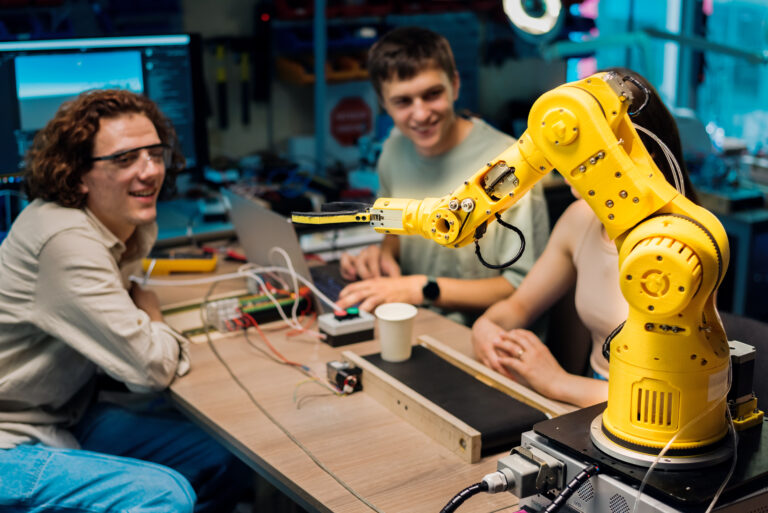
Group of young people doing experiments in robotics in a laboratory. Robot and tools on the table
30 de March de 2026
Cobots have become a key component in the transformation of modern industry. By 2026, collaborative robotics is no longer an emerging technology but a cornerstone of flexible manufacturing, Industry 5.0, and intelligent automation. The global cobot market continues to grow, driven by advances in artificial intelligence, sensor systems, safety technologies, and widespread adoption in both SMEs and large corporations.
This guide explains what cobots are, how they work, the different types available, their industrial applications, the benefits they offer, and why 2026 is a pivotal year for implementing them—especially within innovation ecosystems such as DFactory Barcelona.
What Is a Cobot: Definition
A cobot is an industrial robot designed to work safely and directly alongside humans within a shared space. Unlike traditional industrial robots, cobots incorporate force limitation, advanced sensors, and collision detection, eliminating the need for physical barriers such as safety cages.
Current definitions are based on standards such as:
- ISO/TS 15066, which specifies safe human–robot interaction modes.
- ISO 10218‑2:2025, which integrates collaborative safety criteria and emphasizes that safety depends on system implementation rather than robot type.
Differences Between a Cobot and a Traditional Industrial Robot
| Aspect | Cobot | Traditional Industrial Robot |
|---|---|---|
| Safety | Force‑ and power‑limiting operation | Requires cages and physical separation |
| Programming | Intuitive, low‑code, teach‑by‑hand | Complex, expert‑level programming |
| Installation | Hours or days | Weeks or months |
| Speed | Moderate (up to 4 m/s) | High (6–10 m/s) |
| Flexibility | Easily reconfigured, very adaptable | Rigid, fixed installations |
| Cost | Lower initial investment | Higher investment and maintenance |
These differences make cobots especially attractive in flexible, fast‑changing production environments.
How Cobots Work
Cobots rely on advanced technology that allows them to detect, interpret, and react to human presence in real time. In 2026, cobots integrate generative AI, multimodal sensor technology, and advanced computer vision, making them more precise, safer, and more autonomous than previous models.
Sensor Technology
Modern cobots include:
- Force and torque sensors to detect contact and resistance.
- Tactile “artificial skin” sensors capable of measuring pressure and touch.
- AI‑based computer vision that recognises objects, gestures, and human trajectories.
These systems allow cobots to stop instantly upon contact, avoid collisions, and adjust their movements dynamically.
Safety Systems
Collaborative safety is based on four operating modes:
- Monitored stop
- Hand guiding
- Speed and separation monitoring
- Power and force limiting
More advanced models also include predictive AI‑based safety, capable of anticipating human movement and adjusting robotic behaviour proactively.
Types of Cobots
By Application
- Assembly and handling
- Palletizing and packaging
- Collaborative welding
- Inspection and quality control
- Laboratory automation
- High‑precision pick & place
Plug‑and‑play ecosystems allow tool changes in minutes, increasing versatility.
By Manufacturer
Market leaders include:
- Universal Robots (UR)
- FANUC (CRX series)
- OMRON (TM series)
- KUKA, ABB, Yaskawa
- ESTUN, expanding rapidly with competitive solutions
Each manufacturer offers different payload capacities, reaches, and automation capabilities.
Industrial Applications of Cobots
Assembly and Handling
Cobots can perform repetitive tasks with extremely high precision, making them ideal for electronics assembly, automotive components, and small‑parts manufacturing.
Palletizing
Collaborative palletizing:
- Reduces cycle times
- Minimizes repetitive strain
- Improves overall ergonomics
This application offers one of the fastest returns on investment due to easy integration.
Quality Control
Equipped with AI‑powered vision systems, cobots can:
- Detect microscopic defects
- Analyse 3D shapes and geometries
- Recognize new fault patterns
- Adapt inspection criteria on the fly
Benefits of Implementing Cobots
ROI and Payback
Cobots typically deliver a return on investment in 6 to 18 months, driven by:
- Low initial cost
- Reduced manual repetitive tasks
- Increased productivity
- Fast reconfiguration for new tasks
They help democratize automation for SMEs by lowering technical and financial barriers.
Workplace Safety
Cobots significantly reduce risks associated with:
- Repetitive movements
- Heavy lifting
- Exposure to hazardous environments
- Fatigue‑related injuries
Their safety mechanisms make them essential tools for safer and more ergonomic workplaces.
How to Implement Cobots in Your Company
Integration Steps
- Process analysis
Identify repetitive, physically demanding or hazardous tasks. - Risk assessment
Fundamental for ensuring compliance with current safety standards. - Cobot and tool selection
Grippers, sensors, cameras, welding tools, end‑effectors. - System integration
MES, ERP, conveyors, AGVs, vision systems. - Team training
Intuitive programming reduces the learning curve. - Predictive maintenance
Powered by sensor data and AI‑based diagnostic models.
Cobots at DFactory Barcelona
DFactory Barcelona is one of Europe’s most advanced industrial innovation hubs, bringing together manufacturers, integrators, and technology companies.
Universal Robots, OnRobot and ESTUN
- Universal Robots (UR)
Demonstration units include UR3e, UR5e, UR10e, and UR20—used in assembly, inspection, and palletizing. - OnRobot
A leading provider of collaborative tools such as grippers, vacuum systems, tactile sensors, and vision units. - ESTUN
A growing manufacturer offering high‑performance and cost‑effective collaborative robots.
This combination of UR + OnRobot + ESTUN makes DFactory an ideal environment for testing, validating, and implementing collaborative robotic solutions.
Conclusions
Cobots represent the core of flexible automation in 2026. Far from being simple assistive robots, they have become intelligent, AI‑enhanced systems, capable of safe, efficient, and natural collaboration with humans.
For industrial professionals, engineers and operations managers, cobots offer:
- Flexibility
- Cost reduction
- Safety improvements
- Scalability
- Rapid integration
And in environments like DFactory Barcelona, this technology is accessible, testable, and seamlessly integrable.