Barcelona’s District 4.0 moves forward in its energy transition with new photovoltaic installations
2 de February de 2026
- The Barcelona Free Trade Zone reinforces its leadership in energy transition with more than 283,000 m² of photovoltaic installations, representing a growth of 41.5% compared to 2023.
- This increase highlights the growing commitment of the companies located in District 4.0 to producing clean energy and reducing their carbon footprint.
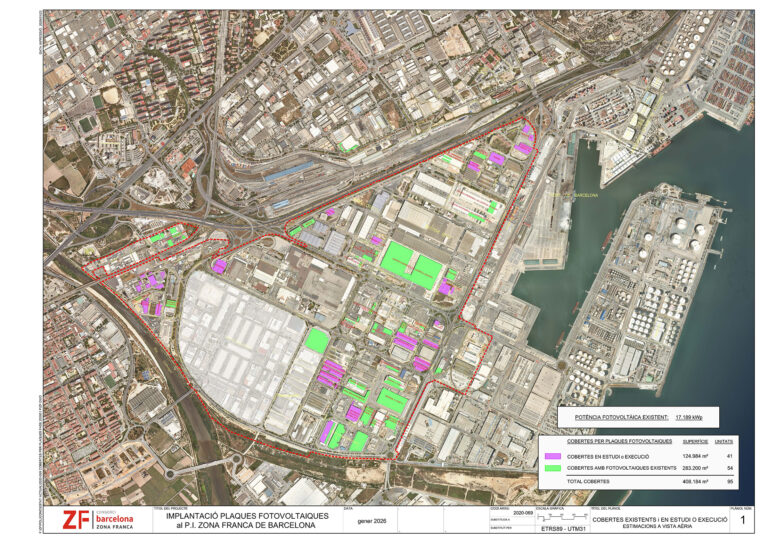
Barcelona, 2 February 2026.- Barcelona’s District 4.0 is making steady progress in its energy transition, with a significant increase in operational photovoltaic solar installations, consolidating its position as a metropolitan benchmark in industrial sustainability. According to an updated study carried out by the Consorci de la Zona Franca de Barcelona (CZFB), the area dedicated to solar energy has grown by 117,654 m² compared with 2023, currently reaching a total of 283,200 m² of active photovoltaic installations. This 41.5% increase demonstrates the growing commitment of the companies located in District 4.0 to producing clean energy and reducing their carbon footprint.
Overall, the operational installations amount to a total installed capacity of 17,189 kWp, representing a significant contribution to the generation of renewable energy in the industrial environment. In addition, the projects already planned will make it possible to reach 19,347 kWp of installed capacity in the coming months, further strengthening the decarbonization process of the industrial estate and its alignment with European climate goals.
In this context, the CZFB is driving the expansion of DFactory Barcelona, the heart of District 4.0, which includes the construction of new buildings designed according to sustainability criteria. All of them will incorporate photovoltaic solar installations that will provide an additional 557 kWp of capacity, directly contributing to emissions reduction and the use of renewable energy within the site.
“The energy transition of District 4.0 is today a tangible reality. The sustained growth of photovoltaic installations shows that industry can be competitive while also being fully committed to sustainability and the fight against climate change,” said Pere Navarro, Special State Delegate at the CZFB. Navarro also stated that “at the Consorci de la Zona Franca de Barcelona, we are creating the conditions for companies to commit to clean energy, innovation and efficiency, consolidating the Zona Franca as a European industrial benchmark aligned with the 2030 Agenda.”
This progress would not have been possible without the drive and active collaboration of the CZFB, which has worked to facilitate and promote the adoption of renewable technologies among the companies in District 4.0. Through these actions, the CZFB reaffirms its commitment to developing a more sustainable, resilient and environmentally respectful industrial model, aligned with the objectives of the 2030 Agenda and global climate challenges.