BWAW 2026 indicates that companies will take decades to achieve real parity
4 de March de 2026
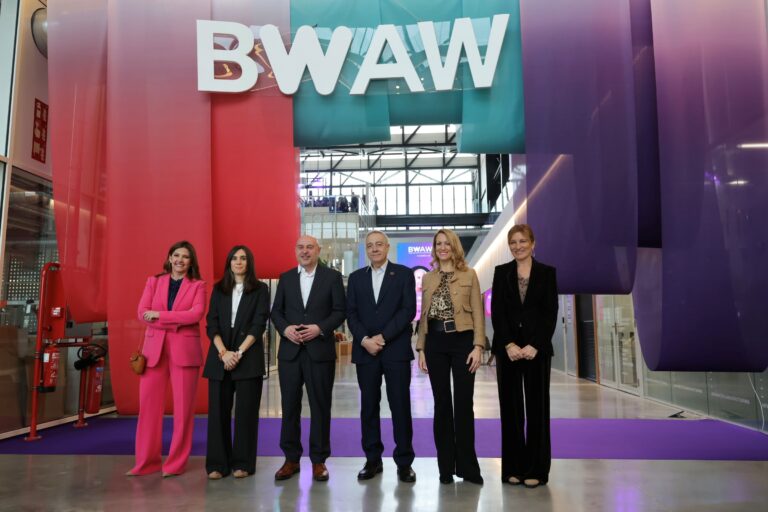
- The Delegate of the Spanish Government in Catalonia, Carlos Prieto; the Executive President of the Consorci de la Zona Franca de Barcelona (CZFB), Pere Navarro; the Deputy President for Economic Development and Tourism of the Barcelona Provincial Council, Ana Maria Martínez; the Deputy Mayor of Barcelona City Council, Maria Eugènia Gay; the Director General for Workplace Equity and Co-responsibility of the Government of Catalonia, Saray Espejo; and the Director General of CZFB, Blanca Sorigué, took part in the opening ceremony of the 6th edition of the Barcelona Woman Acceleration Week (BWAW).
- Organised by the CZFB, this event aims to promote reflection and visibility around female leadership in industry and the economy, and in this edition features 77 speakers and 15 sessions.
Barcelona, 4 March 2026.- The sixth edition of the Barcelona Woman Acceleration Week (BWAW), the benchmark event for advancing gender equality in the business sphere, kicked off this morning. Its goal is to reflect on and highlight female leadership in industry and the economy. Today’s opening sessions highlighted that, although the presence of women in executive positions in Europe continues to grow, the most optimistic studies indicate that parity will not be achieved until 2051. The opening ceremony was presided over by Carlos Prieto, Pere Navarro, Ana Maria Martínez, Maria Eugènia Gay, Saray Espejo, and Blanca Sorigué.
Blanca Sorigué, Director General of the CZFB, stated: “Barcelona Woman Acceleration Week (BWAW) has consolidated itself as a national and international benchmark for promoting gender equality in the professional sphere. At the Consorci de la Zona Franca de Barcelona we remain firmly committed to fostering a fairer, more diverse and more competitive labour market, because equality is not only an ethical principle but also a driver of innovation and economic progress. We cannot afford to overlook 50% of the talent.” She added: “This new edition of BWAW is born with the ambition of generating ideas and alliances that drive real change.”
Pere Navarro, Special State Delegate at the CZFB, emphasised: “Digital transformation cannot advance without real social transformation. Future competitiveness depends on talent, and talent has no gender. Equality does not divide: it balances, adds, and strengthens society as a whole.” He also recalled: “At the CZFB we advocate for a diverse, inclusive, and equitable industry of the future. BWAW is a call for collective action to build a fairer, more innovative and more sustainable future.”
Saray Espejo, Director General for Workplace Equity and Co-responsibility at the Department of Equality and Feminism of the Government of Catalonia, presented relevant data such as “the European Economic Fund, which tells us that it would take us 123 years to achieve equality between men and women if we continue at this pace,” or that “in Catalonia, data confirm that women earn on average 17% less than men and that we devote at least one hour and fifteen minutes more per day than men to care work in the home.” In this context, Espejo emphasized “the importance of creating networks to achieve equality with events like BWAW, where we see role models, create synergies and see the possibility of moving toward a more equal world, because we cannot and do not want to wait that long.”
For her part, Maria Eugenia Gay, Deputy Mayor of the Barcelona City Council, stated that “inequality is amplified in areas such as the digital sphere, where it affects recruitment processes, the ability to make women visible and, therefore, their reputation. Technological governance does not understand inclusion, and it is essential that these biases are not reproduced—biases we highlight at events like the Mobile World Congress.” Gay also referred to the role of women in peacebuilding processes, stressing that “it is well documented that when women participate in these processes, 35% of the agreements reached last more than 20 years.”
In her intervention, Ana Maria Martínez, Deputy President for Economic Development and Tourism of the Barcelona Provincial Council, highlighted that “gender equality needs role models: visible, expert women present in all social and professional spheres. This week, BWAW is the space where female talent is not only recognized but accelerated. Today’s acceleration is marked by technology, transformation, and artificial intelligence. If women do not participate in designing innovation, that innovation will be incomplete and will generate inequalities. We need more women in STEM and in decision-making spaces to guarantee justice, competitiveness, and democratic quality.”
Finally, Carlos Prieto, the Spanish Government’s Delegate in Catalonia, pointed out that “the McKinsey Global Institute notes that reducing the wage gap between men and women to zero would increase global GDP by 20%—that is what is at stake. In Spain, we are modestly doing our homework, as we now have more women working than ever before, a rise in the minimum wage to 1,221 euros—60% of which affects women—and since 2018 employment among women under 30 has increased by 35%, etc. There is still much to do, but progress has been made in recent years.”
Trade unions, key players in creating inclusive workplaces
After the opening ceremony, the first sessions of the programme began. These will run from today until Friday, 6 March, featuring 77 speakers from sectors as diverse as aerospace, real estate, finance, video games, science, talent, architecture, health, digitalisation, communication, multilateral organisations, security forces, corporates and trade unions.
The programme opened with the BUnion vertical and the talk “Building Equality: Trade Unions and Women at the Centre of the Debate”, featuring:
- Camil Ros, Secretary General, Unión de Trabajadoras y Trabajadores de Cataluña
- Mentxu Gutiérrez, Secretary for Women, Feminism and Equality, CCOO Catalunya
- Moderated by Eduardo Magallón, Chief Economics Editor at La Vanguardia
The session stressed the need to reinforce trade union policies that ensure balanced participation between women and men in representation bodies, as gender gaps still persist and hinder women’s access to decision-making roles. It also underlined the importance of gender-perspective training to transform internal cultures and organisational practices. Participants also acknowledged the essential role of trade unions in creating inclusive and discrimination-free workplaces.
Female talent enables more effective healthcare solutions
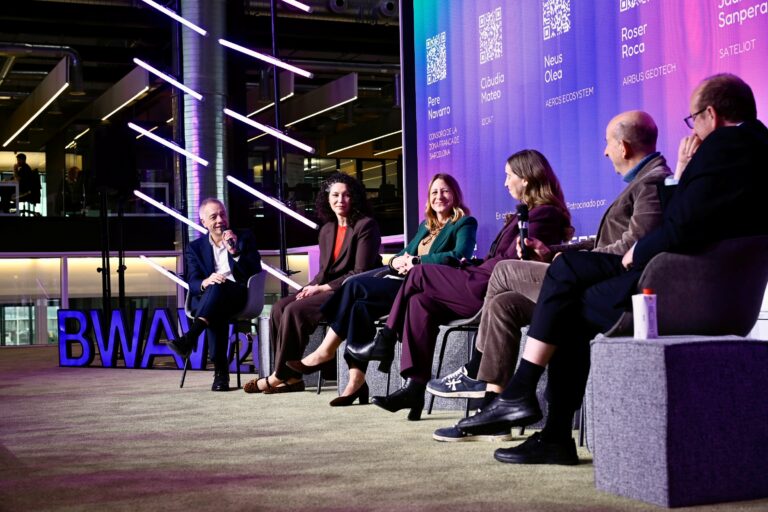
The second session focused on the science and biotechnology sectors. It highlighted that gender equality is essential to driving more innovative biotechnology and truly inclusive future medicine. Increasing female presence in research and leadership accelerates the development of more diverse and effective healthcare solutions. Speakers also emphasised the need to remove structural barriers that still limit women’s access to advanced STEM careers.
Participants included:
- Marta Barrachina, CEO and Co-founder, ADmit Therapeutics
- Esther Riambau, CEO and Co-founder, Oniria Therapeutics
- Arcadi Navarro, Director, Pasqual Maragall Foundation
- Cristina Capdevila, Manager, Bellvitge University Hospital – Viladecans ICS
- Moderated by Pere Navarro, Executive President of the CZFB
The session reaffirmed that diverse teams generate greater creativity and are better equipped to tackle complex healthcare challenges.
Cristina Capdevila described how Bellvitge Hospital is driving healthcare innovation through the CREA model—based on process re-engineering, patient experience, digital transformation and evaluation. She shared examples such as DIAPO, EOSS and innovative public procurement projects developed with the private sector to transform processes and measure impact.
Arcadi Navarro explained that neurodegenerative diseases such as Alzheimer’s are undergoing a paradigm shift thanks to early detection through genomics, biomarkers, neuroimaging and large-scale data analysis. This progress allows a transition from reactive medicine to predictive and preventive medicine, enabling personalised prevention and more effective interventions.
Marta Barrachina highlighted the major entry barriers faced by disruptive health innovations—from regulation to medical adoption and reimbursement. She explained that ADmit’s MAP-AD test, based on NGS, provides early and accurate prediction of Alzheimer’s progression, overcoming the limitations of protein-based diagnostics. Her leadership has transformed a complex molecular technology into a scalable, global solution for personalised dementia medicine.
BDigital and BSecurity
The morning also included sessions on female empowerment and gender equality in digital rights and defence. It was noted that the first woman entered the Spanish Armed Forces—specifically the Air Force—in 1987, just 38 years ago. Speakers stressed the need to eliminate stereotypes and cultural barriers that still hinder women’s access to and promotion within the security sector.
This afternoon the first of the three BWAW 2026 days will conclude with a session dedicated to the video game industry.