CZFB Creates a 3D Model of Barcelona for the World Capital of Architecture
14 de February de 2026
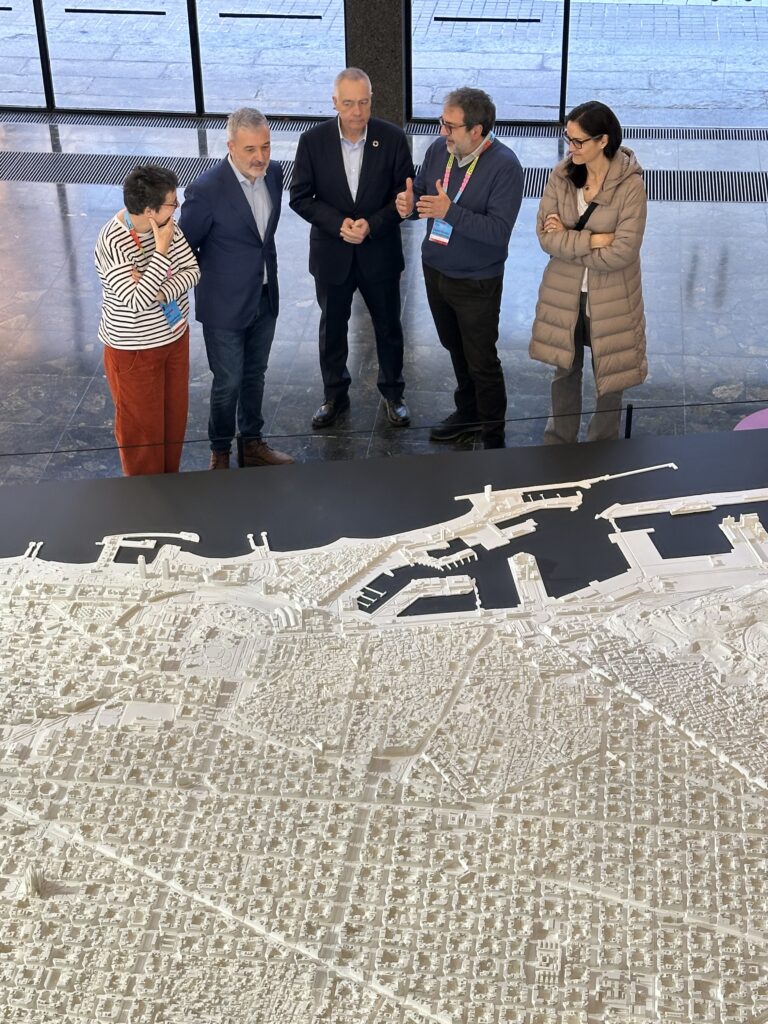
- Jaume Collboni, Mayor of Barcelona; Maria Buhigas, Chief Architect of Barcelona; and Pere Navarro, Special State Delegate at the CZFB, presented this morning the model “Barcelona Plan 2026–2035” in what has been the first event of Barcelona 2026, World Capital of Architecture.
- With a total surface area of 82 m² and made up of 1,204 3D‑printed pieces, it is a unique model for urban analysis and dissemination, which will be permanently installed at the former headquarters of the Gustavo Gili publishing house.
Barcelona, 14 February 2026.- The Consorci de la Zona Franca de Barcelona (CZFB) has completed the production and installation of the new 3D model of the city of Barcelona, a large-format piece conceived as an educational tool, an instrument for urban analysis, and a resource for public dissemination. The Mayor of Barcelona, Jaume Collboni; the Chief Architect of Barcelona, Maria Buhigas; and the Special State Delegate at the CZFB, Pere Navarro, presented this morning the “Barcelona Plan 2026–2035” model in what marked the kick-off of Barcelona 2026, World Capital of Architecture.
This model, developed for the World Capital of Architecture 2026, will be permanently installed at the former headquarters of the Gustavo Gili publishing house, which will become a reference space for activities related to architecture and urban planning beyond the year of celebration. The project was carried out by one of the companies located at DFactory Barcelona, the internationally recognized 4.0 industry ecosystem promoted by the CZFB. The company, Wind Force Investments, spent seven months of intensive work to complete this model, which covers a total surface area of 82 m² and contains 1,204 3D‑printed pieces.
Pere Navarro, Special State Delegate at the CZFB, expressed his gratitude and satisfaction “for having received the commission from the Barcelona City Council to develop this model, a project that symbolizes the Consorci’s commitment to a new way of manufacturing based on innovation and advanced technology. Initiatives like this demonstrate the potential of DFactory Barcelona, as the nerve center of the District 4.0, to generate tangible and high‑impact results.” Navarro also recalled that “the CZFB has historically contributed to Barcelona’s transformation and architecture with iconic buildings, and this model now joins that legacy by placing technology at the service of the city.”
A Living Object to Understand and Imagine the City
The model stands out for its high architectural and topographic detail, allowing the identification of neighborhoods, streets, urban spaces, and unique buildings. It was produced at a 1:1,500 scale using 3D printing technology, advanced digital representation systems, and artificial intelligence techniques that ensured exceptional precision.
The piece has been conceived as an element in constant evolution, capable of incorporating the major urban transformations and strategic projects that will shape Barcelona in the coming years. It also includes layers of digital information and augmented reality that allow users to visualize both the historical evolution of the city and future proposals.
An Unprecedented Technological and Logistical Challenge
Developing the model represented a technological and multidisciplinary coordination challenge. The process included volumetric tests, prototyping, spatial validations, and quality control of each piece. Manufacturing was carried out mainly using the 3D printing resources available at DFactory Barcelona, the main innovation hub in additive manufacturing in southern Europe.
Each piece—measuring up to 35 × 35 cm—was printed in white matte PLA, ensuring durability and visual consistency of the representation. The awarded company also handled the assembly, transport, and installation on a modular base designed specifically for the exhibition space.