
Women engineers in Industry 4.0 and manufacturing
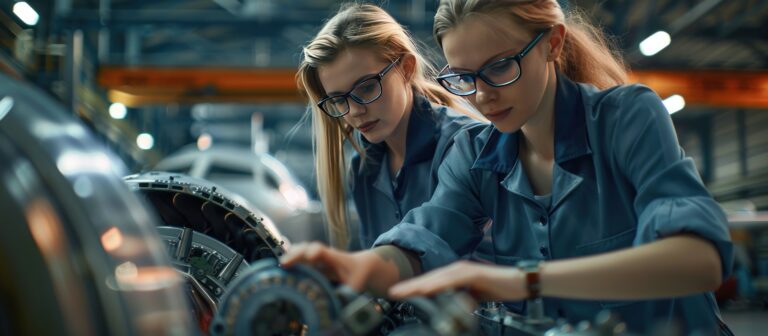
women in blue lab coats are working on a machine. They are wearing glasses and seem to be focused on their task
19 de October de 2026
Women engineers in Industry 4.0 work in areas such as the Internet of Things, manufacturing management and materials research. The careers of Alicia Asín, Teresa Busto and Elena Silveira illustrate different professional pathways in industrial transformation, from connected technology to production processes.
Identifying these professionals and explaining their contributions helps show what working in modern industry involves. Transforming a factory requires engineering knowledge, the ability to validate solutions and teams that connect production, technology and management.
Three careers that illustrate women’s contributions to industry
These professionals represent different specialisms. Their public profiles show how they have developed their education and experience in technology and industry.
Alicia Asín: computer engineering and the Internet of Things
Alicia Asín is a computer engineer and the co-founder and CEO of Libelium. Her speaker profile at 4YFN Barcelona 2026 describes her work with the Internet of Things and applications in industrial digitalisation, environmental monitoring and connected cities.
Her career illustrates one of the areas of Industry 4.0: connecting devices and turning their data into useful information. In an industrial installation, this specialism can involve measuring process variables, supervising equipment or monitoring consumption. Each application requires selecting sensors, ensuring connectivity and validating data quality.
Teresa Busto: manufacturing engineering and management
Teresa Busto is an industrial engineer who graduated from the Technical University of Madrid. The biography published by Indra Group, consulted in October 2026, documents her experience at Airbus: she served as Director of Manufacturing Engineering for the A350 in Toulouse and as Director of the Illescas factory.
Her career illustrates a pathway focused on organising and transforming production. Introducing technology into a factory requires coordination across design, processes, quality and people. Manufacturing management combines those responsibilities with assessing changes and integrating them into factory operations.
Elena Silveira: materials and manufacturing processes
Elena Silveira is a materials engineer and a European Welding Engineer. Her research profile at TECNALIA, consulted in October 2026, describes her work in selecting and manufacturing metallic materials, characterisation, forming, heat treatment and welding.
This specialism highlights how advanced manufacturing also depends on understanding materials and processes. Before introducing a component or changing how it is manufactured, its properties and behaviour need to be checked. Experimental research provides evidence for these decisions alongside digital design and simulation tools.
Skills for working in Industry 4.0
Professional opportunities span technology development, systems integration and operations. The following table brings together skills and examples of work in each specialism.
| Technology area | Technical skills | Example of industrial work |
|---|---|---|
| Industrial Internet of Things (IIoT) | Sensors, connectivity and data quality | Monitor variables on a production line |
| Industrial artificial intelligence | Data analysis and model validation | Assess a defect detection model |
| Robotics and automation | Programming, integration and risk assessment | Integrate a robotic cell into a process |
| Digital twins | Modelling, simulation and connection to real data | Compare operating scenarios for a production line |
| Operational technology (OT) cybersecurity | Industrial networks, asset inventories and access control | Review the protection of control systems |
| Materials and advanced manufacturing | Design, processes and characterisation | Validate materials and manufacturing parameters |
The guide to what a digital twin is explores one of these specialisms. For a business, defining the production problem and validation criteria comes before choosing the technology and identifying the skills needed.
The gender gap in engineering: putting the data in context
According to Spain’s Ministry of Science, Innovation and Universities, women accounted for 28.1% of undergraduate students in Engineering and Architecture in the 2023–2024 academic year. The figure comes from the presentation of Científicas en Cifras 2025, published in March 2025.
This percentage relates to a university subject area. It does not, on its own, measure women’s representation in factories or across all Industry 4.0 jobs. Distinguishing education, employment and management responsibilities makes it possible to analyse each barrier using the appropriate indicator.
The guide to women in STEM in Spain provides further context on education and access initiatives. In industry, making specific technical careers visible helps demonstrate which roles exist and how they connect with businesses.
From role models to projects: Barcelona’s industrial ecosystem
Role models help explain professions; projects provide opportunities to gain experience. The DFactory Barcelona District ecosystem, promoted by the Consorci de la Zona Franca de Barcelona, connects companies and technological activity around Industry 4.0.
To bring more female talent into this transformation, businesses can focus on processes they can assess:
- Skills-based recruitment: specify the knowledge and technical assessments required for each role.
- Access to projects: review who participates in pilots, integrations and investment decisions.
- Professional development: provide mentoring, training and technical career pathways.
- Promotion and monitoring: analyse applications, recruitment, retention and progression using comparable criteria.
These areas complement the education and access initiatives described in the guide to women in STEM. Each business should adapt its approach to its activities and assess progress using its own data.
Frequently asked questions about women engineers and Industry 4.0
Which women engineers are role models in Industry 4.0 and manufacturing?
Alicia Asín in the Internet of Things, Teresa Busto in manufacturing engineering and management, and Elena Silveira in materials and industrial processes illustrate different career paths. Their professional biographies document their education and experience.
What does an engineer do in a connected factory?
Depending on their specialism, an engineer may design systems, integrate sensors, program automation systems, analyse data, validate processes or coordinate production. Responsibilities depend on the role, the installation and the industrial project.
What is the difference between women in STEM and women in industrial engineering?
STEM covers science, technology, engineering and mathematics. Industrial engineering is one part of that field. Industry 4.0 also involves professionals in computing, telecommunications, materials and other specialisms.
What qualifications are needed to work in Industry 4.0?
Requirements depend on the role. Engineering positions may require a specific degree and knowledge of automation, data, networks or processes. Practical training and project experience complement that foundation; the requirements of each position should be checked.
How can a business support women in industry?
It can review recruitment, improve access to technical projects, provide mentoring and training, and assess promotions against clear criteria. Monitoring its own data helps identify the stages at which barriers arise.
Businesses and institutions interested in collaborating with the ecosystem can explore DFactory Barcelona District and contact the Consorci de la Zona Franca de Barcelona.
Related articles
Engineer controls robotic arms by augmented reality industry technology
5 Key Applications of Industrial Machine Learning in Industry 4.0
Engineering team working in smart factory, collecting and analyzing data. Teamworking colleagues using tracking software in industry 4.0 industrial plant equipped with advanced sensors, camera A
The Power of Industrial Big Data: Revolutionizing Efficiency in Industry 4.0
Big Data in Industry 4.0: Transforming Manufacturing