
5 Key Applications of Industrial Machine Learning in Industry 4.0

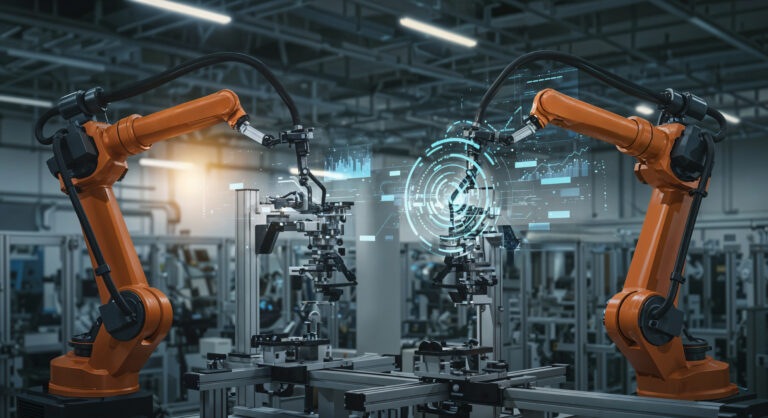
Engineer controls robotic arms by augmented reality industry technology
16 de July de 2026
Industrial machine learning has become a key piece of the digital transformation taking place in the manufacturing sector. If your company still operates with manual processes or disconnected systems, you’re likely leaving opportunities on the table — from reducing waste on the production line to anticipating failures before they bring the factory to a halt. In this guide on industrial machine learning, you’ll discover when it makes sense to make the move, which mistakes to avoid, and what decisions make the difference between a successful project and one that never goes beyond good intentions.
When Should You Implement Industrial Machine Learning in Your Company?
Implementing industrial machine learning is not a passing trend: it’s a strategic decision that can redefine your competitive advantage. When we talk about Industry 4.0, we’re not just referring to connected machines, but to systems capable of learning from the data they generate and improving decisions autonomously.
The clearest competitive advantages include
- Improved operational efficiency: algorithms analyze production patterns in real time and detect bottlenecks that an operator would take hours to identify.
- Cost reduction through automation: repetitive tasks like visual quality inspection are taken over by computer vision models, freeing up personnel for higher-value tasks.
- Increased product quality: machine learning identifies micro-deviations in manufacturing parameters before they turn into defects, reducing rework costs.
Different sectors are already demonstrating the potential of this technology. In automotive, companies that are part of the DFactory Barcelona District ecosystem apply predictive models to optimize the supply chain. In Logistics 4.0, dynamic routing algorithms can reduce distribution fleet mileage by up to 15%. And in the pharmaceutical sector, machine learning accelerates quality control of complete batches in minutes compared to the hours required by traditional methods.
Cost-Benefit Analysis
Before diving in, it’s worth crunching the numbers. Implementing industrial machine learning involves costs on two fronts:
- Software and hardware: from IoT sensors to data analytics platforms and AI model licenses. The initial investment can range from 30,000 to 150,000 euros depending on the project’s scope.
- Training and consulting: your team needs skills in data science and operations. Partnering with specialized institutions, such as research institutes linked to innovation hubs, reduces the learning curve.
Against these costs, the benefits materialize in sustainable savings. A study of the European manufacturing sector estimates that companies implementing machine learning achieve an average 20% increase in productivity and a 25% reduction in unplanned downtime during the first year. The return on investment typically falls between 12 and 18 months when the project is well-defined.
5 Common Mistakes When Implementing Industrial Machine Learning and How to Avoid Them
Learning from others’ mistakes saves you time, money, and frustration. These are the five most frequent mistakes companies make when adopting industrial machine learning:
1. Underestimating the project’s complexity
Many executives assume that buying AI software and connecting it to their machines is enough. The reality is that machine learning needs clean data, well-mapped processes, and an infrastructure that supports the flow of information. Avoid this mistake by starting with a scoped pilot project: one production line, one specific process, one measurable goal.
2. Not having adequately trained personnel
If your team doesn’t understand what a machine learning model does, they won’t be able to interpret its results or feed it correctly. The solution is to invest in training before implementation. Initiatives like the debate forum to anticipate disruptive and emerging changes shaping the global economy and drive innovation show how the Catalan industrial ecosystem is prioritizing upskilling as the foundation of digital transformation.
3. Not properly assessing the company’s needs and objectives
Implementing AI for the sake of implementing AI is a recipe for failure. Before writing a single line of code, define what problem you want to solve: reduce waste by 10%? Anticipate 80% of breakdowns? Without a clear objective, there’s no way to measure success.
4. Not considering integration with existing systems
Your factory already has ERPs, SCADAs, and management systems. Industrial machine learning must communicate with all of them, not live in a separate bubble. Plan the integration architecture from day one and make sure communication protocols (OPC UA, MQTT) are compatible.
5. Not planning for data security and privacy
The connectivity that makes Industry 4.0 possible also opens up new attack surfaces. A machine learning model that feeds on sensitive production data needs perimeter protection, encryption, and access policies. OT cybersecurity is not optional; it’s part of the project from the design stage.
Key Decisions for a Successful Industrial Machine Learning Implementation
If you’re wondering how to keep your project from stalling halfway through, here’s a five-step decision framework that leading innovation companies follow:
- Clearly define objectives and goals: translate the business vision into concrete metrics. “Improve efficiency” won’t cut it; “reduce cycle time on line B by 12% in six months” will.
- Evaluate available technologies and tools: from cloud platforms like AWS SageMaker or Azure ML to on-premise solutions for industrial environments. Each use case has an optimal tool.
- Allocate adequate resources and budget: an industrial machine learning project isn’t funded with spare change. Dedicate a specific budget covering hardware, software, training, and ongoing support.
- Establish key performance indicators (KPIs): OEE (overall equipment effectiveness), MTBF (mean time between failures), and defect rate are metrics that let you assess the real impact of machine learning.
- Plan for the training and support needed: technology without people doesn’t transform anything. Design a training plan that covers everyone from operators to executives, and make sure you have post-implementation technical support.
Companies and research institutes collaborating in innovation ecosystems, such as those grouped within the DFactory Barcelona District, demonstrate that cooperation between entities accelerates technology adoption and reduces risks. Joining your company with a living ecosystem, where learnings and resources are shared, can be the difference between moving forward alone or moving forward fast.
Frequently Asked Questions
What is industrial machine learning?
It’s the application of artificial intelligence techniques that enable industrial machines and systems to learn from the data they generate, improve their decisions autonomously, and optimize production processes without the need for explicit programming for each case.
What are the advantages of implementing industrial machine learning?
The main advantages include greater operational efficiency, cost reduction through automation, improved product quality, predictive maintenance capabilities, and supply chain optimization.
How can I avoid common implementation mistakes?
Start with a scoped pilot, invest in prior training, define measurable objectives, plan integration with current systems, and don’t neglect cybersecurity from the project’s design stage.
Your Next Step Toward Industry 4.0
Industrial machine learning is no longer a technology of the future: it’s a tool that companies of all sizes are using today to gain competitiveness. The key doesn’t lie in the technology itself, but in how you integrate it with your processes, your team, and your business strategy.
If you want to be part of the new industrial economy and connect with an ecosystem where innovation is tangible, discover the DFactory Barcelona District ecosystem and learn how the companies within it are leading the transformation toward Industry 4.0. Subscribe to the newsletter to stay up to date with the latest news, events, and opportunities that can drive your next industrial machine learning project.
Related articles

Engineering team working in smart factory, collecting and analyzing data. Teamworking colleagues using tracking software in industry 4.0 industrial plant equipped with advanced sensors, camera A
The Power of Industrial Big Data: Revolutionizing Efficiency in Industry 4.0

Big Data in Industry 4.0: Transforming Manufacturing
Computer Vision: The Revolution in Industrial Automation