
What is Industry 4.0: complete guide 2026
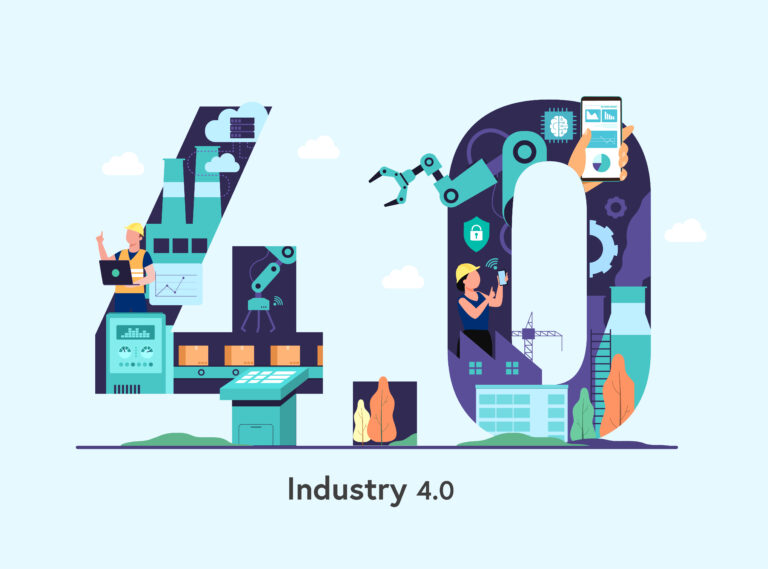
Industry 4.0
8 de June de 2026
What is Industry 4.0? Definition
Industry 4.0 is the fourth industrial revolution, based on the integration of intelligent digital technologies—IoT, artificial intelligence, big data and robotics—in production processes. It allows machines, systems and people to be interconnected in real time to create connected, autonomous production environments capable of making data-driven decisions.
Industry 4.0 represents a structural change in the way we produce, manage and distribute goods and services. It is not just about automating processes, but about making them intelligent, connected and adaptive.
The fourth industrial revolution in context
The concept was born in Germany around 2011, within an industrial strategy to strengthen competitiveness through the digitalization of the industry. Since then, it has established itself as a global standard for industrial transformation.
Unlike previous revolutions, the differentiating factor is the constant interconnection and the capacity for analysis in real time, which allows much more flexible and efficient production systems.
Key Features
- Total digitization of industrial processes
- Connectivity between machines (M2M), systems and people
- Artificial intelligence for decision making
- Autonomy of production systems
- Real-time data as the basis for optimization
The 4 industrial revolutions
Industry 1.0 — Mechanization
Started in the 18th century with the steam engine, it allowed production processes to be mechanized and production capacity to increase.
Industry 2.0 — Mass production
In the late 19th century, electricity and assembly lines transformed mass production, reducing costs and increasing scale.
Industry 3.0 — Automation
Starting in the 70s, electronics and computing introduced automation, with PLCs, industrial robots and digital systems.
Industry 4.0 — Digitalization
The current stage integrates data, artificial intelligence and connectivity to create intelligent production systems.
Industry 4.0 Technologies
Industrial Internet of Things (IIoT)
Connected devices that collect data from machines and processes in real time, allowing constant monitoring and informed decision making.
Sensors and industrial sensors
The basis of digitalization: they capture variables such as temperature, vibration or energy consumption.
Artificial Intelligence and big data
They allow you to analyze large volumes of data to detect patterns, anticipate incidents and optimize processes.
Collaborative robotics (cobots)
Robots designed to work alongside people, increasing productivity without completely replacing labor.
Additive manufacturing (3D printing)
Layer-by-layer production that reduces waste and allows great customization.
Digital twins
Virtual replicas of physical assets that allow you to simulate behaviors and anticipate problems.
Augmented and mixed reality
Visual assistance in complex operations, maintenance and training.
Industrial cybersecurity
Protects operational technology (OT) systems against digital threats in connected environments.
Benefits of Industry 4.0 for the company
The implementation of Industry 4.0 technologies provides multiple advantages:
- Increased productivity
- Reduction of unplanned stops thanks to predictive maintenance
- Product quality improvement
- Productive flexibility in the face of demand changes
- Energy efficiency
- Complete process traceability
The real impact will depend on the company’s degree of digital maturity and the correct selection of use cases.
How to implement Industry 4.0
Industrial digital transformation is not immediate. The recommended process is progressive:
1 Assessment of the current situation
Analyze the level of digitalization and identify opportunities.
2 Definition of a pilot case
Choose a specific project with measurable objectives.
3 Implementation and validation
Test the pilot in a real environment.
4 Progressive scaling
Extend the solution to other areas.
Industry 4.0 in Catalonia: DFactory Barcelona District
One of the differentiating factors of this guide is the focus on a real ecosystem: the DFactory Barcelona District, promoted by the Barcelona Free Zone Consortium (CZFB).
According to data provided by CZFB management in May 2026, the hub had:
- Nearly 50 companies installed, with full employment
A waiting list of about 60 companies
More than 70% of international companies
63 patents generated in less than a year
A current building of 17,000 m² and more than 50,000 m² under development
A planned final complex of more than 100,000 m²
5,000 professional visits annually
(according to data provided by the CZFB management, May 2026)[20260528 -…pleta 2026 | PDF]
This ecosystem positions Barcelona as a benchmark in industrial innovation in Europe.
Priority sectors
- Mobility: electric vehicle, urban logistics, drones
- Health: medical robotics and diagnosis with AI
- Food: advanced packaging and circular economy
Examples of innovation
- Industrial 3D printing
- Surgical robots
- New sustainable materials such as algae-based packaging. The value of DFactory lies in the concentration of companies, technology and talent in a single space, generating real synergies and applied innovation.
Frequently asked questions (FAQs)
What is Industry 4.0?
It is the fourth industrial revolution based on the integration of digital technologies in production to create connected and intelligent systems.
What technologies does it include?
IIoT, artificial intelligence, big data, collaborative robotics, 3D printing, digital twins, augmented reality and cybersecurity.
What benefits does it provide?
Increased productivity, cost reduction, quality improvement, flexibility and energy optimization.
How is it implemented?
Through a progressive process: diagnosis, pilot, validation and scaling.
Are there examples in Catalonia?
Yes. The DFactory Barcelona District is one of the main Industry 4.0 hubs, with international companies and applied innovation.
Conclusions
Industry 4.0 is not a passing trend, but a structural transformation of the global industry. Its adoption allows companies to be more efficient, competitive and adaptive.
In this context, ecosystems such as the DFactory Barcelona District demonstrate that industrial innovation is no longer a theoretical idea, but a tangible reality with economic and technological impact.
Related articles
Engineer in photovoltaics factory uses tracking software on tablet to review performance of robot arms manufacturing solar panels. Expert uses device to inspect solar plant machinery, camera A closeup
Digital Twin: Industrial Applications and Real-World Use Cases (with Examples from Spain)
Engineer controls robotic arms by augmented reality industry technology
5 Key Applications of Industrial Machine Learning in Industry 4.0
Engineering team working in smart factory, collecting and analyzing data. Teamworking colleagues using tracking software in industry 4.0 industrial plant equipped with advanced sensors, camera A
The Power of Industrial Big Data: Revolutionizing Efficiency in Industry 4.0