
Industrial Artificial Intelligence: Complete Guide for Businesses

Relaxed asian man wandering around city streets at night, looking around to surrounding skyscrapers in metropolitan urban setting. Businessman leaving work, taking a walk outside empty town
2 de July de 2026
p>Industrial artificial intelligence is no longer a promise of the future: it is a reality that is reshaping how factories, warehouses, and supply chains operate in 2026. If you manage operations, lead innovation, or seek a competitive edge for your company, understanding how to apply this technology can make the difference between leading your industry or falling behind. In this guide to industrial artificial intelligence, you’ll learn what concrete applications it has, what real benefits it brings to Industry 4.0, and how you can take your first steps to integrate it into your processes.
How Is Artificial Intelligence Transforming Industry?
Industrial artificial intelligence is changing the rules of the game in sectors that have been operating in much the same way for decades. What once required constant human oversight can now be managed by algorithms that learn from data and make decisions in real time.
In the DFactory Barcelona District ecosystem, there are already companies demonstrating the potential of this transformation. A clear example is the case of Anybotics expands its global presence with a new engineering and AI hub at DFactory Barcelona, where autonomous robotics is combined with AI to inspect industrial facilities without human intervention.
The benefits achieved by these companies include
- Reduced unplanned downtime thanks to early fault detection.
- Operational cost savings through optimized energy consumption.
- Improved workplace safety by delegating hazardous tasks to intelligent systems.
The main challenge these companies have overcome is the integration of AI with legacy systems. Many factories operate with machinery that was never designed to connect to the cloud, and the solution involves installing IoT sensors that act as a bridge between traditional equipment and data analytics platforms. There’s no need to replace the entire infrastructure: you can start gradually.
Applications of Artificial Intelligence in Industry
If you’re wondering what the applications of artificial intelligence in industry are, the answer spans from the production line to logistics management. Here are the three most impactful ones in 2026:
Industrial process automation
AI-driven automation goes beyond traditional robotics. Today’s systems can adjust production parameters in real time based on raw material conditions, temperature, or demand. For example, an assembly line can automatically slow down if it detects that product quality is declining, with no need for human intervention.
Predictive maintenance with sensors and data analytics
Predictive maintenance is likely the application with the highest return on investment. By installing sensors on critical machinery, AI algorithms analyze vibrations, temperature, power consumption, and other parameters to predict when a component will fail before it happens. This allows repairs to be scheduled during low-activity periods, avoiding costly downtime.
Supply chain optimization
AI can analyze millions of variables —from weather to geopolitical events— to optimize logistics routes, forecast demand spikes, and manage inventories dynamically. If you want to dive deeper into the industrial context, you can check out what is Industry 4.0 complete guide 2026 to understand how AI fits within the fourth industrial revolution ecosystem.
Benefits of Artificial Intelligence in Industry 4.0
The benefits of artificial intelligence in Industry 4.0 are tangible and measurable. These are not abstract concepts but concrete improvements to the bottom line.
Improved production efficiency
Efficiency translates to more units produced with fewer resources. An AI system can identify bottlenecks on the production line that an operator wouldn’t detect, redistributing workloads across machines to balance the flow. Industry studies indicate that implementing AI in production can increase efficiency by 15% to 30%.
Reduced operational costs
Predictive analytics cuts spending on emergency spare parts, idle hours from downtime, and wasted energy. AI-driven process optimization allows facilities to adjust their power consumption based on actual workload, resulting in direct savings on energy bills.
Increased productivity and competitiveness
Companies that adopt industrial AI gain the ability to respond quickly to market changes. They can reconfigure production lines in hours instead of days, launch customized products at scale, and compete in markets where flexibility is key. As highlighted in DFactory Barcelona recognized as one of the world’s best innovation zones, ecosystems that integrate these technologies position themselves as global benchmarks.
Challenges and Opportunities in Implementing Industrial AI
Adopting industrial artificial intelligence is not without its difficulties. Understanding the challenges helps you anticipate them and plan accordingly.
Challenges in AI integration
The main obstacles are
- Lack of structured data: many companies have data scattered across incompatible formats.
- Resistance to change: operators and middle managers may see AI as a threat rather than a tool.
- Initial investment: although ROI is high, the upfront outlay for sensors, software, and training can be significant.
Opportunities for innovation and continuous improvement
AI is not a project you implement and forget about. It is a platform for continuous improvement: the more data it accumulates, the better its predictions. This opens up constant opportunities for innovation, from new business models based on predictive services to digital twins that allow you to simulate changes before applying them. Innovation and talent as key drivers for business growth and advancement are the pillars supporting this transformation.
Mitigating risks associated with AI
To reduce risks, it’s advisable to start with low-cost pilot projects, train the team in parallel, and establish OT cybersecurity protocols specific to connected industrial environments.
Next Steps for Companies Looking to Adopt Industrial AI
If your company wants to make the leap into industrial AI, the path doesn’t have to be overwhelming. These steps will help you structure the process:
- Assess your current processes: identify which areas consume the most resources, where most downtime occurs, and which tasks are most repetitive.
- Identify areas for AI improvement: prioritize those where a predictive or automation system would have the greatest immediate impact. Predictive maintenance is usually an ideal starting point.
- Develop an implementation plan: define measurable objectives, budget, timelines, and success metrics. Start with a 3- to 6-month pilot project before scaling.
- Find a supporting ecosystem: being part of a specialized environment accelerates the learning curve. Ecosystems like DFactory Barcelona strengthens its 4.0 ecosystem with the incorporation of Solport show how collaboration between tech companies facilitates technology adoption.
Frequently Asked Questions about Industrial Artificial Intelligence
How much does it cost to implement AI in a factory?
It depends on the scope. A predictive maintenance pilot project can start from a few thousand euros with basic sensors and analytics software. Large-scale implementation requires a larger investment, but the average ROI falls between 12 and 18 months.
Is robotics necessary to use industrial AI?
No. AI can be applied without robots, analyzing production data, optimizing logistics routes, or forecasting demand. Robotics expands the possibilities, but it’s not a requirement. If you’re interested in this area, you can read about what is robotics types applications and trends 2026.
Does industrial AI replace workers?
Not necessarily. AI automates repetitive, low-value tasks, allowing staff to be redirected toward supervision, analysis, and continuous improvement roles. Team training is a key part of the process.
Conclusion
Industrial artificial intelligence is a competitive lever that leading companies are already leveraging in 2026. It doesn’t require a radical transformation from day one: it’s enough to identify a critical process, start with a measurable pilot, and scale based on results. If your company wants to be part of the new industrial economy, the first step is understanding where the value lies and taking action. Discover the DFactory Barcelona District ecosystem and connect with companies that are already leading this transformation.
Related articles
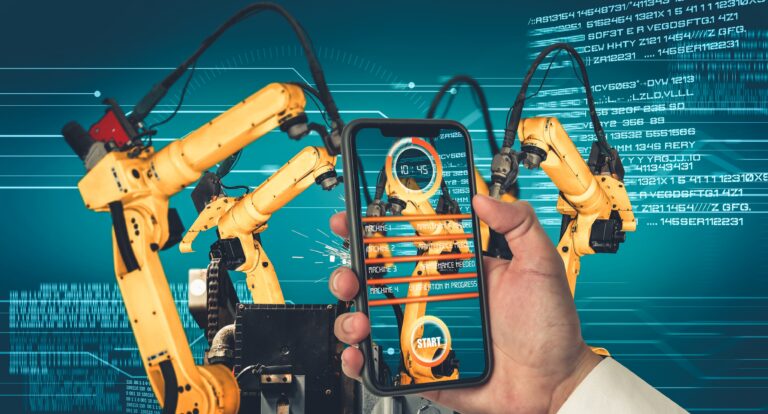
Engineer controls robotic arms by augmented reality industry technology
5 Key Applications of Industrial Machine Learning in Industry 4.0

Engineering team working in smart factory, collecting and analyzing data. Teamworking colleagues using tracking software in industry 4.0 industrial plant equipped with advanced sensors, camera A
The Power of Industrial Big Data: Revolutionizing Efficiency in Industry 4.0
Big Data in Industry 4.0: Transforming Manufacturing