
Computer Vision: The Revolution in Industrial Automation
3 de July de 2026
Imagine that at your factory, an operator had to inspect 10,000 parts per shift one by one, searching for micro-defects nearly invisible to the naked eye. Exhausting, right? Well, computer vision does this job in seconds, without fatigue and with a precision that surpasses the human eye. In this guide, you’ll discover what it is, how it works, and why it has become one of the flagship technologies of Industry 4.0.
What Is Computer Vision and How Does It Work?
Computer vision is the ability of a computer system to interpret digital images and make decisions based on them. Think of it as “the eyes and brain” of a machine: a camera captures the image and software analyzes it to detect patterns, measure objects, identify defects, or recognize people.
Its history dates back to the 1960s, when early researchers dreamed of teaching machines to “see.” However, for decades the results were limited. The real breakthrough came with machine learning and, more specifically, with deep learning, which allows systems to learn from enormous volumes of images without the need to program every rule manually.
Today, Computer Vision Combines Multiple Disciplines
- Image processing: transforms the visual signal from the camera into numerical data that the software can interpret.
- Machine learning: enables the system to improve its accuracy with every new image it processes.
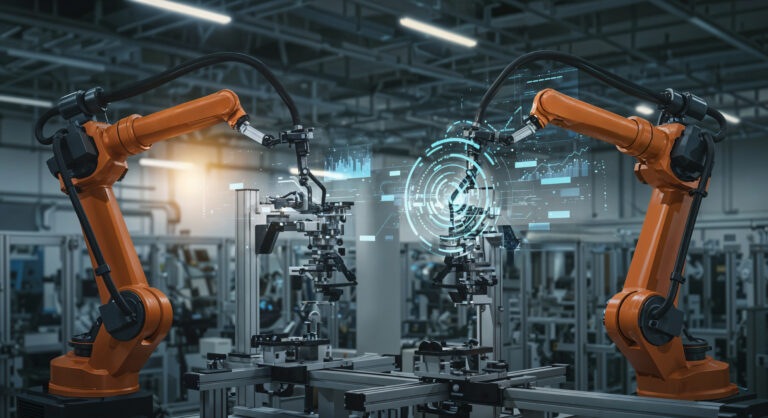
- Robotics: integrates visual capabilities into mechanical arms and production lines to automate complex tasks.
Key Technologies in Computer Vision
Behind every computer vision system lies a set of technologies that work together. These are the most relevant in 2026:
- Deep learning: neural networks with multiple layers that learn to distinguish increasingly complex features in images.
- Convolutional Neural Networks (CNN): a specific type of neural network designed to process data with a grid structure, such as the pixels of an image. They are the current standard for classification and object detection tasks.
- Image signal processing: techniques that enhance visual quality (noise reduction, contrast adjustment) before the model analyzes the image.
These technologies don’t work in a vacuum. They require a connected and digitalized industrial ecosystem, like the one driven by initiatives such as the digitalized and connected industry, where sensors, cameras, and management systems exchange data in real time.
Applications of Computer Vision in Industry 4.0
Computer vision is no longer a future promise: it’s an operational reality in thousands of industrial plants. Its impact spans sectors as diverse as automotive, food, pharmaceuticals, and electronics.
Some of the Most Widespread Applications Are
- Automated quality inspection: detects surface defects, incorrect measurements, or missing parts on high-speed lines. A camera with computer vision can inspect 100% of production, something impossible manually.
- Process automation: robotic arms equipped with vision can sort, assemble, and package products, adapting to variations in shape or position in real time.
- Industrial safety and surveillance: monitoring of hazardous areas, intrusion detection, or verifying that operators are wearing proper protective equipment.
Companies like BMW, Siemens, or Pfizer have been integrating these systems for years. In BMW’s case, computer vision inspects welds on car bodies with a false positive rate below 0.1%. If you want to dive deeper into the return on this type of investment, we recommend reading about industrial automation: benefits, costs, and real ROI.
Computer Vision in Logistics 4.0
One of the sectors where computer vision is having the greatest impact is logistics. Logistics 4.0 demands speed, precision, and traceability, and computer vision delivers all three:
- Package sorting and tracking: cameras with OCR (optical character recognition) read labels and barcodes at conveyor belt speed, assigning each package to its correct route.
- Inventory management: drones equipped with computer vision navigate automated warehouses, counting stock and detecting misplaced items.
- Delivery route optimization: visual analysis of traffic and road conditions feeds algorithms that adjust routes in real time.
Leading events like the SIL eDelivery Barcelona Congress put the spotlight on these innovations every year, connecting logistics companies with visual technology developers.
Development and Implementation of Computer Vision Solutions
If you’re considering integrating computer vision into your company, the path isn’t as complex as it seems, but it requires methodology. These are the key steps:
- Hardware selection: choose cameras with the appropriate resolution, capture speed, and lighting for your environment. An industrial camera is not the same as a conventional security camera.
- Model design and training: collect a representative dataset of images (with and without defects, for example) and train a machine learning model. Data quality determines the quality of the result.
- Integration with existing systems: connect the vision system with your ERP, MES, or SCADA so that visual decisions translate into operational actions.
- Testing and debugging: validate the system under real conditions before full deployment. Adjust sensitivity thresholds to balance false positives and false negatives.
Tools and Frameworks for Computer Vision Development
You don’t need to build everything from scratch. The open source community has developed powerful and accessible tools:
- OpenCV: the reference library for image processing. It supports over 2,500 optimized algorithms and works in C++, Python, and Java.
- TensorFlow: Google’s framework for deep learning, with specific modules for vision (TensorFlow Lite for edge devices).
- PyTorch: preferred by the research community for its flexibility and ease of debugging. Ideal for prototyping CNN models.
- Scikit-Image: a Python library for pixel-level image processing, useful for preprocessing and segmentation tasks.
The choice will depend on your team, your infrastructure, and your use case. The important thing is to start with a well-scoped pilot project and scale from there.
Frequently Asked Questions About Computer Vision
What’s the difference between computer vision and machine vision?
In practice, the terms are used interchangeably. Technically, computer vision is the broader academic field, while machine vision is applied in industrial and automation environments.
Do I need a lot of infrastructure to get started?
Not necessarily. You can launch a pilot with a mid-range industrial camera, a PC with a GPU, and an open source framework. The initial investment can range from 3,000 to 15,000 euros depending on complexity.
Does computer vision replace operators?
No. Its function is to complement human work, freeing operators from repetitive tasks and allowing them to focus on higher-value activities, such as predictive maintenance or quality supervision.
Next Steps: How to Integrate Computer Vision into Your Innovation Strategy
If you’ve made it this far, you now have a solid foundation on what computer vision is and how it can transform your industrial operations. The next step is to move from theory to action.
We Suggest This Roadmap
- Identify application areas within your company where visual inspection, sorting, or tracking creates bottlenecks.
- Assess the technological maturity of your plant: do you have sufficient connectivity? Does your staff have basic digital skills?
- Develop a phased implementation plan: pilot, validation, scale-up. Define clear KPIs (defect reduction, throughput increase, cost savings).
- Seek allies in innovation ecosystems that connect your company with startups and technology centers.
Initiatives like the agreement between DFactory and Barcelona Tech City to drive a technological ecosystem in Barcelona or the projects that CZFB and Economists Barcelona foster to drive innovative, high-value-added projects are examples of how the Catalan institutional environment is facilitating access to technology for companies of all sizes.
Computer vision is not a passing trend: it’s a fundamental piece of the Industry 4.0 puzzle. The sooner you start exploring it, the sooner you’ll be in a position to compete in an increasingly automated and demanding market.
Want to be part of the new industrial economy? Discover the DFactory Barcelona District ecosystem and learn about our Logistics 4.0 and additive manufacturing incubators. Subscribe to our newsletter to stay up to date with the latest innovations in automation and industrial technology.
Related articles
Engineer in photovoltaics factory uses tracking software on tablet to review performance of robot arms manufacturing solar panels. Expert uses device to inspect solar plant machinery, camera A closeup
Digital Twin: Industrial Applications and Real-World Use Cases (with Examples from Spain)
Engineer controls robotic arms by augmented reality industry technology
5 Key Applications of Industrial Machine Learning in Industry 4.0

Engineering team working in smart factory, collecting and analyzing data. Teamworking colleagues using tracking software in industry 4.0 industrial plant equipped with advanced sensors, camera A
The Power of Industrial Big Data: Revolutionizing Efficiency in Industry 4.0