Advanced Printed Electronics by Thinex Rotimpres Arrives at DFactory Barcelona
13 de April de 2026
- The company strengthens the internationally renowned Industry 4.0 ecosystem of Barcelona’s Zona Franca with ultra-thin, flexible and sustainable solutions that turn any object into a smart interface.
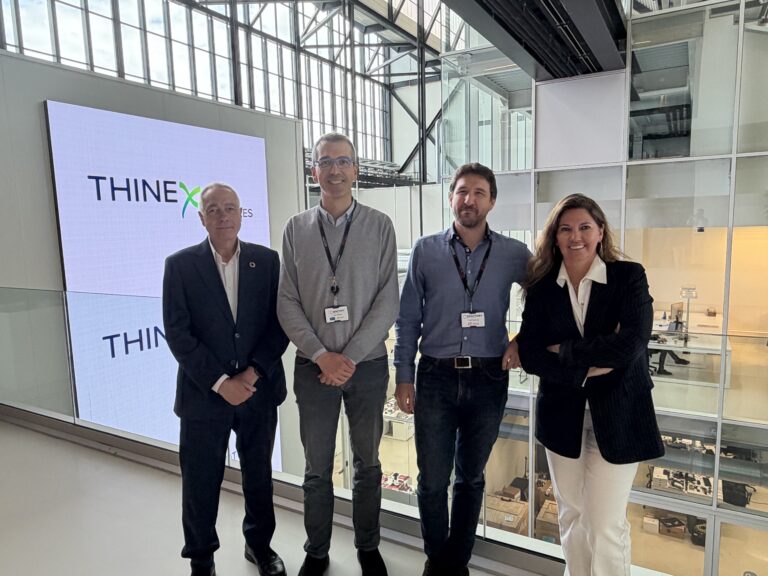
- Pere Navarro, Executive President of the CZFB, and Blanca Sorigué, Director General of the organisation, met with Lluís Quintana and Marc Vizern, Business Development Manager and Business Unit Manager of Thinex Rotimpres respectively, to welcome them to the ecosystem.
Barcelona, 13 April 2026.– Thinex Rotimpres, Thinex Rotimpres, a pioneering company in advanced printed electronics, has joined DFactory Barcelona, the benchmark Industry 4.0 ecosystem promoted by the Barcelona Free Zone Consortium (CZFB). With this addition, DFactory Barcelona incorporates a new key player in printed electronics, industrial innovation and enabling technologies for digital and sustainable transformation.
Thinex Rotimpres is able to print ultra-thin and flexible electronic components on substrates such as paper, plastic or textiles, enabling any object to become a smart, connected and sustainable interface. Its approach goes beyond technological development: the company co-creates solutions together with its clients, supporting them from the ideation phase through to industrialisation, adapting to the specific needs of each industry.
Applications of the printed electronics developed by Thinex Rotimpres include smart packaging, product authentication, functional sensors, touch keyboards, flexible heaters and smart biosensors, adding new functionalities and value to sectors as diverse as industry, logistics, automotive, healthcare and retail. Thinex Rotimpres is the printed electronics division of Rotimpres, an industrial company with more than 40 years of experience in premium printing and a strong commitment to innovation. Thanks to decades of industrial know-how and continuous investment in R&D, Thinex Rotimpres works to redesign and expand the limits of what is possible with printed electronics, offering scalable, reliable solutions ready for industrialisation.
Production at Thinex Rotimpres is based on roll-to-roll technology, enabling the efficient, industrial-scale manufacturing of high-quality printed electronic components while maintaining the flexibility required to customise each solution according to customer requirements. Among its most notable milestones, the company has developed printed strain sensors for NASA, integrated into parachute fabrics for space missions. These sensors proved their ability to operate under extreme conditions without compromising material strength or performance, marking a milestone in the application of printed electronics in the aerospace industry and reaffirming the potential of Catalan technological innovation in the world’s most demanding environments.
Marc Vizern, Business Unit Manager at Thinex Rotimpres, stated that “our decision to become part of DFactory responds to the goal of connecting with leading companies in digital transformation, exploring emerging Industry 4.0 trends and discovering opportunities where printed electronics can improve connectivity, sustainability and intelligent functionality in industrial applications”.
For his part, Pere Navarro, Executive President of the CZFB, stated that “Thinex Rotimpres perfectly represents the spirit of DFactory Barcelona: an industrial company that innovates, co-creates with its clients and transforms knowledge into solutions ready for industrialisation. Its arrival enriches the 4.0 ecosystem and opens up new opportunities for collboration in key areas such as advanced materials, flexible electronics and smart connectivity”.
Finally, the Director General of the CZFB, Blanca Sorigué, also welcomed the incorporation of Thinex Rotimpres into the DFactory Barcelona ecosystem, highlighting that “it reinforces our commitment to a new industry based on technology, innovation and sustainability. Its leadership in advanced printed electronics demonstrates how industrial talent and R&D developed in our territory can generate high value-added solutions and compete in the most demanding environments worldwide”.