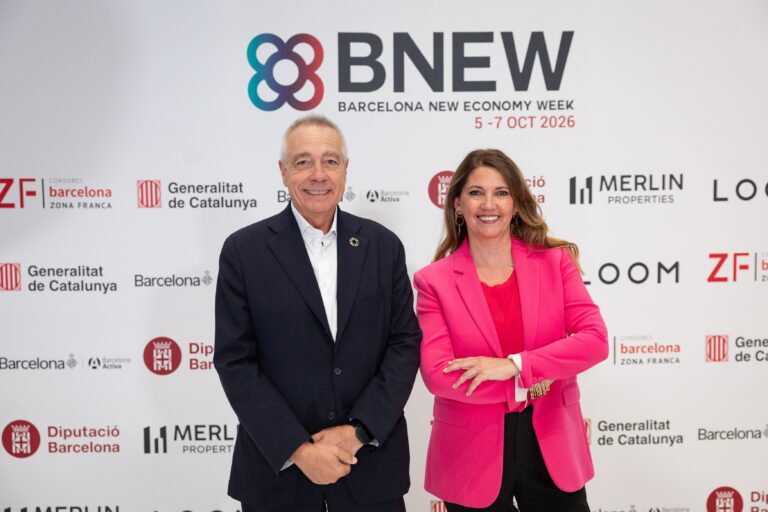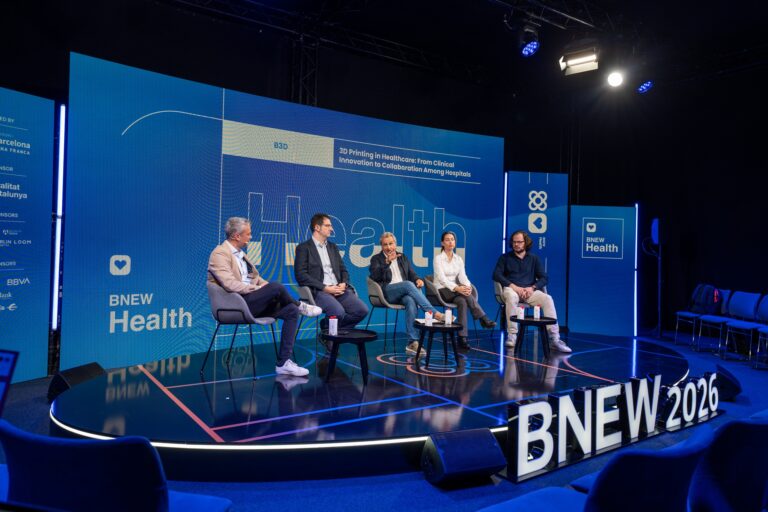
The 7th edition of BNEW kicks off, connecting technology, transformation, and opportunities.
5 de October de 2026
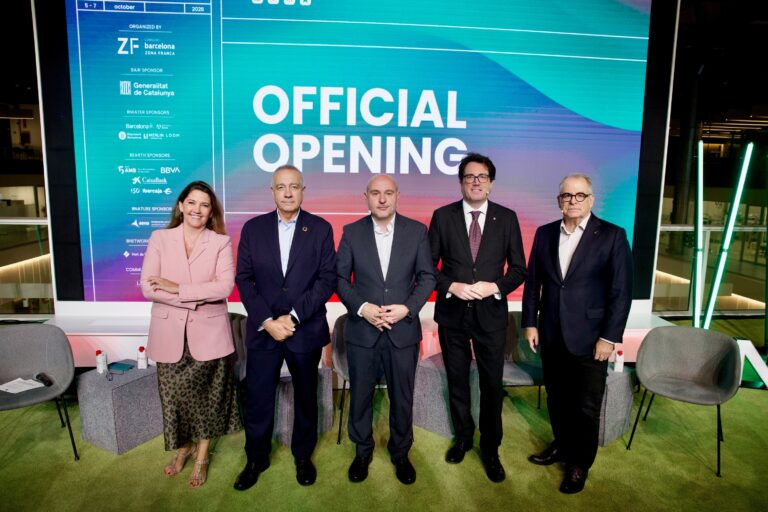
- Barcelona New Economy Week (BNEW 2026) officially kicked off with an opening ceremony attended by the Spanish Government Delegate in Catalonia, Carlos Prieto; the Deputy Mayor for Economy, Finance, Economic Promotion and Tourism at Barcelona City Council, Jordi Valls; the Secretary for Business and Innovation of the Government of Catalonia, Jaume Baró; the Special State Delegate and Executive President of the Consorci de la Zona Franca de Barcelona (CZFB), Pere Navarro; and the CEO of the CZFB, Blanca Sorigué.
- BNEW AI, BNEW Agrofood, and BNEW Science verticals took centre stage on the first day, bringing together international experts to discuss the challenges and opportunities that will shape the future.
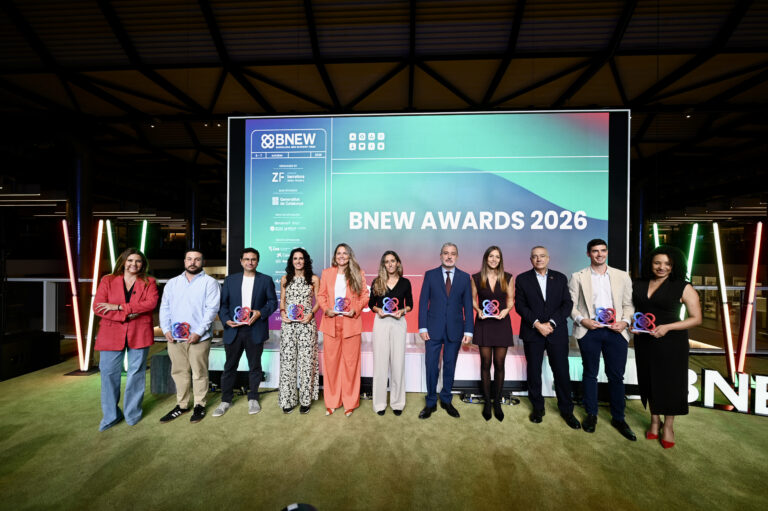
- Today at 7:00 p.m., BNEW 2026 will recognise the most innovative startups across its eight verticals with the presentation of the BNEW 2026 Awards, in a ceremony presided over by the Mayor of Barcelona, Jaume Collboni.
Barcelona, October 5, 2026. The seventh edition of Barcelona New Economy Week (BNEW), organised by the Consorci de la Zona Franca de Barcelona (CZFB), kicked off this morning by bringing together eight key sectors of activity under a common theme: the new economy, with the aim of generating new business opportunities and knowledge. AI, Agrofood, Science, Gaming and Energy are the new sectors introduced in this edition, joining Aviation & Space, Talent and Health, further consolidating BNEW as a benchmark event for emerging and strategic sectors of the economy.
This edition features 270 speakers, more than 100 startups, 50 sessions and over 50 experiential activities, complementing the content agenda and creating new networking opportunities in a more interactive and engaging environment, transforming DFactory Barcelona into a true “living lab” of the new economy.
Opening Ceremony of the 7th Edition
BNEW 2026 officially opened its doors this morning with an inauguration ceremony attended by the Spanish Government Delegate in Catalonia, Carlos Prieto; the Deputy Mayor for Economy, Finance, Economic Promotion and Tourism at Barcelona City Council, Jordi Valls; the Secretary for Business and Innovation of the Government of Catalonia, Jaume Baró; the Executive President of the Consorci de la Zona Franca de Barcelona (CZFB), Pere Navarro; and the CZFB’s General Director, Blanca Sorigué.
Blanca Sorigué, CEO of the CZFB, opened the event by highlighting that “BNEW is much more than an event; it is the meeting point where the new economy becomes tangible. Over these three days, we will discover which technologies are already transforming our productive sectors and who is leading this change. The uniqueness of BNEW lies in its ability to connect very diverse fields through knowledge, innovation and talent. We want attendees to see, touch, test and experience the technologies that are shaping the future. Because at BNEW we do not only talk about the new economy: we experience it first-hand and turn it into real opportunities for companies and professionals”.
During the inauguration of BNEW 2026, the Executive President of the CZFB, Pere Navarro, highlighted the evolution of an event “that was born in a context of great uncertainty and that, seven editions later, has consolidated itself as one of the major international gatherings of the new economy”. Navarro emphasized “BNEW’s ability to constantly reinvent itself, incorporating new realities and challenges without losing its essence: anticipating the transformations that will shape the future”. He also underscored the role of DFactory Barcelona “as a living laboratory where innovation is experienced first-hand and where companies, institutions and entrepreneurs can see how new technologies are already transforming entire industries”. For the Executive President of the CZFB, “BNEW represents Barcelona’s determination to lead, create opportunities and actively participate in the major global economic transformations”.
The Secretary for Business and Innovation of the Government of Catalonia, Jaume Baró, congratulated the CZFB on the 7th edition of BNEW, which he described as “a reward for perseverance and a key innovation event that has become a permanent fixture on Barcelona’s calendar.” He also highlighted the ability of Barcelona and Catalonia to maintain a strong industrial base that supports the development and sustainability of new technologies. “Technologies will not endure unless we have an industrial country, and we need a more sovereign industry with fewer dependencies,” he stated. Finally, he referred to “the importance of innovation and the ability to adapt to change. BNEW is a clear example of this, incorporating new verticals and showcasing innovation and technology.”
For his part, Jordi Valls, Deputy Mayor for Economy, Finance, Economic Promotion and Tourism of Barcelona City Council, highlighted “Barcelona’s role as a city committed to a more resilient, innovative and competitive economic model, capable of integrating industry, technology and knowledge.” Valls also defended “the commitment to innovation and dual-use technologies as essential tools for strengthening strategic autonomy and creating new development opportunities.” Furthermore, he underscored “the importance of promoting artificial intelligence from a European perspective, pointing out that its impact goes beyond technology and extends into the geopolitical sphere.” In this context, he emphasized the need to develop homegrown capabilities that strengthen economic and technological sovereignty, while also highlighting Barcelona’s transformation towards higher value-added activities linked to innovation and technology.
Finally, Carlos Prieto, the Spanish Government Delegate in Catalonia, praised “BNEW’s pioneering role as an initiative born in the midst of the pandemic thanks to the vision and determination of Pere Navarro and Blanca Sorigué.” He also highlighted the evolution of the project and the growth of DFactory Barcelona, “which has expanded from 17,000 to more than 60,000 square metres dedicated to innovation and Industry 4.0, serving as an example of a transformation that has been successfully planned and executed.” Likewise, he defended the commitment to science, technology and artificial intelligence as drivers of competitiveness, stressing the importance of the European Next Generation funds and of a stronger, more autonomous Europe. Finally, he reaffirmed “the importance of institutional collaboration and investment in innovation as key factors in addressing the economic and technological challenges of the future.”
Throughout the three days of BNEW, eight vertical sectors with a significant impact on global digital transformation will take centre stage. The panels and activities dedicated to AI, Agrofood, and Science were held today, while tomorrow will feature Aviation & Space, Talent, and Health. On 7 October, the focus will shift to Energy and Gaming, along with the startup pitches from the finalists of the BNEW 2026 Awards.
Artificial Intelligence: A Driver of Economic and Social Transformation
Artificial intelligence (AI) took centre stage on the opening day with the launch of BNEW AI. This new vertical brought together experts from the business, technology and institutional spheres to examine the transformative role of artificial intelligence in both the economy and society. Participants included Diego Perino, Director of the BSC AI Institute; Mike Blackman, Managing Director of Integrated Systems Europe (ISE); Neema Balolebwami, AI expert and CEO of NEEMA AI; and Ricardo Oliver, Head of AI Transformation for BBVA Spain, among others.
Throughout the various sessions, speakers highlighted how AI is becoming a key tool for enhancing competitiveness, optimising processes, and creating new business opportunities. Discussions also explored the impact of this technology on industry, the need to accelerate its adoption in a responsible and sustainable manner, and the challenges associated with regulation, data governance, and the development of the talent required to lead this transformation.
The programme also placed special emphasis on the practical application of artificial intelligence in strategic areas such as public administration, where it is already helping to improve management and decision-making through real-world success stories. In addition, participants reflected on the future of work and the evolution of professional skills in a context increasingly shaped by collaboration between people and technology.
The sessions concluded with an analysis of European technological sovereignty and the importance of promoting innovation that is ethical, trustworthy, and aligned with societal values, ensuring that advances in AI contribute to both economic progress and collective well-being.
Innovation and Sustainability to Transform the Food Supply Chain
Another of the new features introduced at this edition of BNEW was BNEW Agrofood, a new vertical focused on the major transformation challenges facing the agri-food sector from a technological, sustainable, and competitive perspective. Throughout the day, discussions explored how artificial intelligence, predictive models, sensor technologies, and digital twins are enabling the development of smarter agricultural ecosystems, capable of optimising water use, anticipating climate-related risks, and strengthening the resilience of farming operations. Experts also highlighted the role of data as a key tool in driving a more efficient, sustainable, and resilient agricultural sector, better equipped to address the challenges posed by climate change.
The programme also explored the major trends that will shape the future of food and agri-food production in Europe, with sessions focused on alternative proteins, precision fermentation, regenerative agriculture, carbon farming, and new production models driven by automation and robotics. In addition, discussions addressed innovation in packaging and adaptation to the new European regulatory framework, as well as the need to accelerate the sector’s transformation in order to enhance competitiveness, attract talent, and create new growth opportunities. Overall, BNEW Agrofood demonstrated how technological innovation and sustainability have become the main drivers of a new generation of agri-food systems that are more resilient, efficient, and future-oriented.
Scientific Innovation for a World in Transformation
Finally, the BNEW Science vertical focused on how science and technology are redefining the boundaries of innovation and accelerating the creation of knowledge. Speakers agreed that breakthroughs in areas such as advanced materials, nanotechnology, and artificial intelligence are opening up unprecedented opportunities to transform sectors as diverse as healthcare, energy, electronics, and sustainability.
Participants also highlighted that the ability to design materials with unprecedented precision, together with the use of advanced technologies to accelerate research, will make it possible to address some of the major scientific, industrial, and societal challenges of the coming decades more effectively.
The various sessions also underscored the importance of interdisciplinary collaboration and shared knowledge as key drivers of innovation. Participants stressed that today’s challenges, ranging from climate change and space exploration to the creation of a more inclusive and diverse scientific community, require cooperation across disciplines, institutions, and industries.In this context, speakers emphasised the need to foster open ecosystems that encourage knowledge sharing, ensure equal opportunities for female talent, and facilitate the faster and more impactful transfer of scientific advances to both the market and society.
Particular mention should be made of the outstanding calibre of speakers at BNEW Science, which this year featured renowned international experts such as Fátima López-Fernández, Technology Transfer Manager at the Computer Vision Center; Alejandro Sánchez, Director of the Industry Relations Office at ALBA Synchrotron; and Isabel Pérez Ennes, Head IT Region Europe at Novartis, among others.
BNEW 2026 Awards for the Best Startups
This afternoon, starting at 7:30 p.m., the BNEW 2026 Awards for the Best Startups ceremony will take place, recognizing the most outstanding initiatives developed by emerging companies across each of the eight vertical sectors featured in this edition.
The awards ceremony will be chaired by Jaume Collboni, Mayor of Barcelona, and will conclude with a networking cocktail reception on the terrace of DFactory Barcelona.