
Metal 3D Printing: Technologies, Materials, and Use Cases
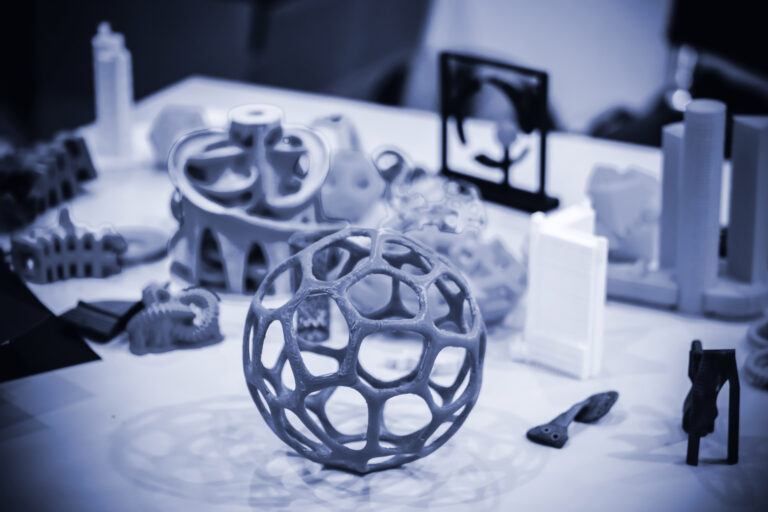
Models printed by 3d printer. Copy space. Objects printed on a 3d printer on a table. Modern additive technologies 4.0 industrial revolution. Blue gray color.
14 de April de 2026
Metal 3D printing has established itself as a strategic technology within industrial 3D printing, transforming the way companies design, validate, and produce metal components. In 2026, its impact goes far beyond prototyping: it enables on‑demand production, supply chain optimization, and significant cost reduction in advanced industrial environments.
This article provides a comprehensive and practical overview of what metal 3D printing is, why it is key to today’s industry, which technologies and materials make it possible, and how it is being applied in sectors such as automotive, aerospace, and advanced manufacturing, with a special focus on projects developed at DFactory Barcelona.
What Is Metal 3D Printing?
Definition and key concepts
Metal 3D printing encompasses a set of additive manufacturing technologies that allow metal parts to be created directly from a digital model (CAD design), building them layer by layer. Unlike traditional processes—such as machining or casting—industrial metal 3D printing removes many geometric limitations and enables highly optimized designs.
Key concepts associated with this technology include:
- Design for Additive Manufacturing (DfAM)
- Topological optimization and structural lightweighting
- Functional prototyping and end‑use production
- Customization and on‑demand manufacturing
Thanks to more efficient material usage and direct integration between CAD design and production, metal 3D printing plays a key role in the transition toward more sustainable manufacturing models.
Why Is Metal 3D Printing Important in 2026?
Current trends
In 2026, the adoption of metal 3D printing is driven by technological maturity and a clear industrial need for flexibility and resilience. Technologies such as DMLS/SLM and HP Metal Jet have reached reliability levels compatible with demanding production environments.
Key trends include:
- Integration of industrial 3D printing within Industry 4.0 environments
- Use of simulation and digital twins to validate designs
- Growing adoption for short and medium production runs
- Reduced dependence on external suppliers
Opportunities for industry
Metal 3D printing offers clear opportunities for industrial companies:
- Reduced lead times
- Local and decentralized manufacturing
- Re‑engineering of existing components
- Production of critical spare parts without the need for physical inventory
These advantages make metal additive manufacturing a strategic complement to traditional processes.
Types and Categories of Metal 3D Printing
Main classification
Within industrial metal 3D printing, several technologies exist, each aimed at different production needs.
Powder Bed Fusion (PBF)
This category includes technologies such as DMLS (Direct Metal Laser Sintering) and SLM (Selective Laser Melting). They use a high‑power laser to fuse metal powder layer by layer, offering high precision and excellent mechanical properties.
Binder Jetting / HP Metal Jet
HP Metal Jet technology, available in the laboratories at DFactory Barcelona, deposits a binding agent onto metal powder, followed by a sintering process. It is particularly suitable for volume production and industrial scalability.
Directed Energy Deposition (DED)
More focused on part repair and material addition onto existing components, typically used in industrial maintenance applications.
Practical Applications of Metal 3D Printing
Real‑world industry examples
Metal 3D printing is already widely applied across multiple industrial sectors:
- Aeronautics and aerospace: structural brackets, lightweight components, and complex internal geometries
- Automotive: tooling, molds, functional prototypes, and end‑use parts
- Energy industry: heat exchangers and high‑temperature components
- Industrial machinery: customized parts and obsolete or out‑of‑catalog spare parts
Projects developed at DFactory Barcelona
At DFactory Barcelona, laboratories specialized in metal 3D printing work with technologies such as HP Metal Jet and DMLS/SLM systems, developing real projects for industrial companies:
- Functional prototyping in stainless steel and aluminum
- Short production runs for industrial validation
- Component optimization through CAD design
- Local production with reduced lead times
DFactory acts as an ecosystem where companies, engineering firms, and technology centers collaborate to bring industrial metal 3D printing into real production environments.
Key Benefits of Metal 3D Printing
The adoption of metal 3D printing provides clear and measurable benefits:
- Cost reduction for complex parts
- Elimination of molds and tooling
- Greater design freedom
- Integration of multiple functions into a single part
- Improved sustainability and reduced waste
- Increased supply chain robustness
How to Implement Metal 3D Printing in Your Company
Recommended steps
For effective implementation of industrial metal 3D printing, a progressive approach is recommended:
- Identify candidate parts with high added value
- Redesign components using additive manufacturing principles
- Select the appropriate metal technologies and materials
- Validate through functional prototypes and testing
- Scale up to production and integrate into the industrial workflow
Working with technology partners and environments such as DFactory Barcelona helps accelerate the process and reduce risks.
Conclusions
Metal 3D printing has evolved from an emerging technology into a key tool within industrial 3D printing. In 2026, companies that integrate it strategically gain agility, reduce costs, and strengthen their innovation capacity.
Adopting metal additive manufacturing is not just a technological decision, but a commitment to a more flexible, sustainable, and future‑ready production model.
Next step?
Explore how metal 3D printing can be applied to your industrial processes through the ecosystem and laboratories at DFactory Barcelona
Related articles
Engineering team working in smart factory, collecting and analyzing data. Teamworking colleagues using tracking software in industry 4.0 industrial plant equipped with advanced sensors, camera A
The Power of Industrial Big Data: Revolutionizing Efficiency in Industry 4.0
Big Data in Industry 4.0: Transforming Manufacturing
Computer Vision: The Revolution in Industrial Automation