
Collaborative Robots vs Traditional Robots: Which to Choose in 2026
OnRobot
7 de April de 2026
Choosing between a collaborative robot (cobot) and a traditional industrial robot is rarely a binary decision: it depends on the task, the volume, the environment and the investment horizon. From DFactory Barcelona District, promoted by the Consorci de la Zona Franca de Barcelona (CZFB), where both technologies coexist, we summarise the criteria applied in practice, how to calculate total cost and the mistakes that most often make industrial automation projects more expensive.
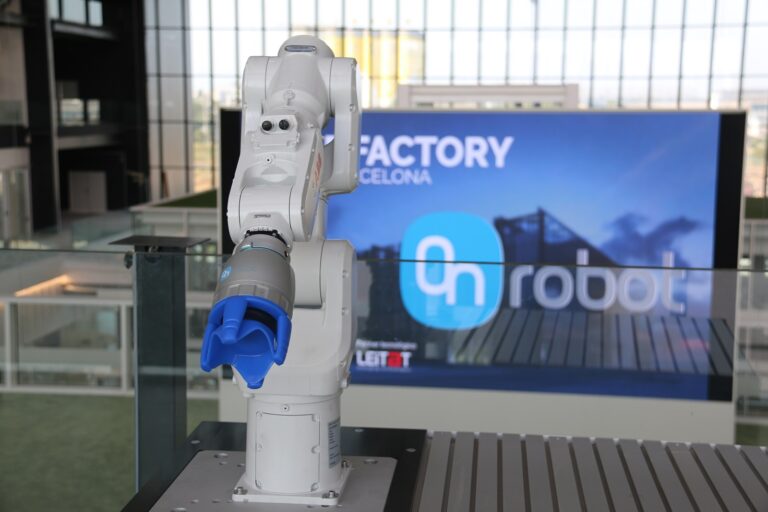
OnRobot robotics laboratory at DFactory Barcelona District.
Cobot or industrial robot: the short answer
If the product changes often, you produce small or medium batches and a person needs to work alongside the robot, a cobot is usually the better choice. If you manufacture high volumes with little variation, or need high speed, heavy payloads or continuous cycles, an industrial robot is the usual answer. Hybrid set-ups also exist: cobots inside cells with guarding, and industrial robots with advanced sensing that allow some degree of collaboration.
Three axes settle most cases:
- Product variability. Frequent changeovers favour the cobot (quick reprogramming); a product that stays stable for months favours the industrial robot.
- Volume and cycle rate. Low or medium output with irregular demand points to a cobot; high cycle rates and continuous operation point to an industrial robot.
- Environment. A shared workspace with operators points to a cobot; a closed cell with only occasional human presence points to an industrial robot.
Safety shapes the design in all three cases (see below), and purchase price alone decides nothing: what matters is total cost of ownership.
What a cobot is (and where to read more)
A collaborative robot is designed to share space with people without complex fencing, thanks to sensors, force and torque control and intuitive programming. Models range from payloads of a few kilos up to around 30 kg in the largest on the market, such as Universal Robots’ UR30. For the full definition, the classification by payload, application and level of collaboration, and sector trends, see the guide What are cobots and, for the general picture, What is robotics. This article focuses on how to decide.
Reference comparison at DFactory
At DFactory Barcelona, the arrival of Universal Robots in the Industry 4.0 ecosystem makes it possible to compare two complementary approaches in the same environment: a cobot (Universal Robots) for flexible processes and variable production, and a traditional robot (KUKA) for high speed, heavy payloads and closed environments.
| Criterion | Cobot (e.g. Universal Robots) | Traditional robot (e.g. KUKA) |
|---|---|---|
| Safety | Built-in functions; can operate without fencing if the application’s risk assessment allows it | Normally in a cell with guarding |
| Flexibility | Very high | Medium |
| Programming | Intuitive (hand guiding or graphical interface) | Complex; expert or offline programming |
| Speed | Medium (limited by safety when in contact with people) | Very high |
| Payload | Low to medium; up to around 30 kg in the largest models | Medium to high; heavy models go well beyond that |
| Repeatability | Between ±0.02 and ±0.1 mm depending on the model (manufacturer datasheets) | Very high; check each model’s datasheet |
| Integration | Lower, although grippers and safety systems add cost | Higher investment in cell, guarding and floor space |
| Investment | Moderate | High |
| ROI | Short to medium term in variable processes | Medium to long term; pays off with stable volume |
The decision should be based on the production process, not on the technology alone.
When an industrial robot is still the best option
Cobots complement traditional robots; they do not replace them. An industrial robot remains preferable when there is:
- High-volume, low-mix production (automotive, household appliances, food).
- High-precision or heavy-load work: robotic welding, machining, heavy palletising.
- An environment where human presence is occasional or absent.
- 24/7 operation, where every tenth of a second per cycle drives the return on investment.
When a cobot pays off
- Short runs, variable products and frequent format changes.
- Repetitive or ergonomically demanding tasks where the person stays at the workstation (pick and place, screwdriving, machine tending, quality control).
- Companies that want to start automating with a lower barrier to entry and scale up gradually.
- Processes affected by a shortage of technical profiles, thanks to more accessible programming.
Safety and regulation
This is where projects most often slip. Three ideas are worth keeping clear:
- Safety is a property of the application, not of the cobot. A collaborative arm can be part of a hazardous cell if the application is not properly assessed. The revision of the ISO 10218 series published in 2025 reflects this approach: Part 1 covers the robot itself, Part 2 covers the application and the cell, and the collaboration requirements that used to sit in the technical specification ISO/TS 15066 are now integrated into it.
- CE marking applies to the complete machine, that is, the robotic cell, not just the arm. The integrator is responsible for it.
- The European framework is changing. Regulation (EU) 2023/1230 replaces the Machinery Directive 2006/42/EC and will apply, with exceptions, from 20 January 2027. Confirm with the integrator which framework applies to the project, depending on the date it enters service.
In collaborative applications, protective measures are combined, such as safety-rated monitored stop, hand guiding, speed and separation monitoring and power and force limiting. Choosing the right ones changes the cell design and its cost.
Safety checklist before integrating a cobot
- Has a risk assessment been carried out for the whole task (including workpiece, tool and surroundings)?
- Are the protective measures that apply to the collaboration defined?
- Have contact forces and pressures been validated in the real application?
- Will the complete cell have a declaration and CE marking, and who is responsible for it?
- Is there specific training for operators and maintenance staff?
Total cost and ROI: how to compare properly
The myth that a cobot is always cheaper
A cobot usually has a lower purchase price, but the total cost includes integration, tooling (grippers, fixtures), safety systems, training, maintenance, reprogramming and downtime. In many projects these items weigh as much as the arm itself or more, and in a process with little variation the TCO can even out or favour the industrial robot.
To compare, add up: initial investment, integration, tooling, training, maintenance, energy, unplanned downtime and reprogramming, and set the result against the investment horizon. The indicators that discriminate best are payback, OEE, cost per cycle and flexibility in the face of product changes.
A simple reference for payback: total installed cost divided by net monthly savings.
In changing processes, a cobot’s ROI can exceed that of a rigid solution; in stable, high-volume processes, the break-even point shifts towards the industrial robot.
Five common mistakes when choosing (and how to avoid them)
- Deciding on purchase price without calculating TCO. Work out the total installed cost before comparing.
- Assuming a cobot is safe by definition. It depends on the risk assessment and the application.
- Underestimating integration and tooling. This is the budget line that most often overruns; ask for quotes that include grippers and safety.
- Ignoring future product variability. You buy for today and produce for three years from now.
- Not training staff or planning maintenance. Without training, the cobot’s flexibility goes to waste.
How to implement: pilot, validation and scale-up
An efficient implementation follows this order: process analysis and objectives, risk assessment, model selection, integration with systems and sensors (including MES and ERP), team training and measurement of results. At DFactory Barcelona we promote a pilot, validation and scale-up approach: test with the real part and the real operator before buying, define success KPIs (cycle rate, quality, availability, cost per cycle) and involve production, maintenance and risk prevention from the first meeting.
Robotics ecosystem and suppliers in Barcelona
Barcelona has an advanced industrial robotics ecosystem, with manufacturers, specialised integrators, innovation centres such as DFactory Barcelona and start-ups linked to AI and automation. This environment, part of the DFactory Barcelona District (industry 4.0 district), supports technology transfer. You can read about its growth in the expansion of DFactory Barcelona and about the wider context in the guide to what Industry 4.0 is and in the factories of the future.
When evaluating integrators, look at:
- Experience in your sector and in similar applications.
- Ability to integrate with existing PLC, MES and ERP systems.
- After-sales support and real availability of spare parts.
- Training and technical documentation included.
- Verifiable references and accessible case studies.
Frequently asked questions about collaborative and traditional robots
What exactly does a cobot do?
It carries out repetitive low- to medium-payload tasks while sharing space with people: pick and place, screwdriving, quality control or machine tending.
Can a cobot replace an industrial robot?
Only if the cycle rate and payload allow it. In high-volume, high-speed production, the industrial robot remains the most efficient option.
Is a cobot safe on its own?
No. Safety depends on the complete application: the risk assessment, the protective measures chosen and the validation of the cell.
What regulation applies to collaborative robotics?
The ISO 10218 series (revised in 2025, with the collaboration requirements integrated into Part 2), CE marking of the complete cell and occupational risk prevention legislation. In addition, Regulation (EU) 2023/1230 will replace the Machinery Directive from 20 January 2027.
How long does a cobot take to pay for itself?
It depends on the process, the number of shifts and the total installed cost. Calculate it with your own data before deciding.
How to decide: final checklist
Before signing, go through ten points: product variability, volume and cycle rate, shared environment, payload and reach required, repeatability required, risk assessment, integration cost, planned training, maintenance and scalability plan. If you are unsure about three or more, you need a pilot before investing.
At DFactory Barcelona we support companies and professionals in evaluating, testing and implementing advanced robotics technologies. Discover DFactory Barcelona and its incubators, and subscribe to the newsletter for Industry 4.0 analysis and real company cases.
Related articles

Engineer in photovoltaics factory uses tracking software on tablet to review performance of robot arms manufacturing solar panels. Expert uses device to inspect solar plant machinery, camera A closeup
Digital Twin: Industrial Applications and Real-World Use Cases (with Examples from Spain)
Engineer controls robotic arms by augmented reality industry technology
5 Key Applications of Industrial Machine Learning in Industry 4.0

Engineering team working in smart factory, collecting and analyzing data. Teamworking colleagues using tracking software in industry 4.0 industrial plant equipped with advanced sensors, camera A
The Power of Industrial Big Data: Revolutionizing Efficiency in Industry 4.0