The United Nations Global Compact Spain and the CZFB bring together nearly 200 companies to promote sustainability as a competitive advantage.
16 de June de 2026
- The event “Sustainability and Business Competitiveness” highlighted the strategic role of ESG criteria in strengthening companies’ resilience, innovation, and profitability.
- Catalonia already has more than 345 participating entities in the Global Compact, consolidating its position as one of the autonomous communities with the highest representation within the initiative.
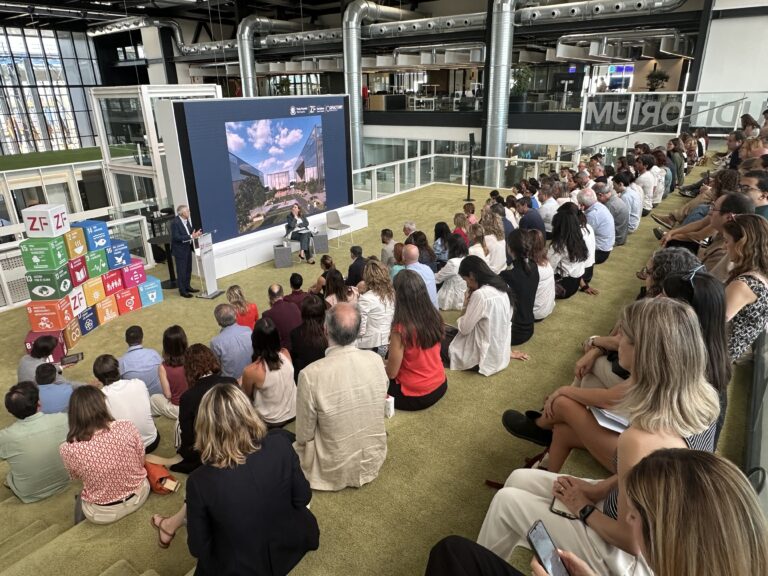
Barcelona, June 16, 2026.- The United Nations Global Compact Spain held the “Sustainability and Business Competitiveness” event at DFactory Barcelona, in collaboration with the Consorci de la Zona Franca de Barcelona. The event brought together nearly 200 representatives from Catalonia’s business and industrial ecosystem to discuss how sustainability has become a key factor for competing in an increasingly demanding environment.
During the opening, Pere Navarro, Executive President of the Consorci de la Zona Franca de Barcelona, highlighted that “for the Consorci de la Zona Franca de Barcelona, it is a privilege to host this event together with the United Nations Global Compact Spain, an organization we have been associated with since 2017 and with which we share the commitment to advancing the Ten Principles and the 2030 Agenda. At CZFB, we always work aligned with the Sustainable Development Goals, understanding sustainability as a real driver of competitiveness: it enables innovation, anticipation, differentiation, and the creation of greater value. This conversation makes perfect sense at DFactory Barcelona, an ecosystem where Industry 4.0, innovation, and collaboration help build a more sustainable, efficient, and inclusive productive model.”
For her part, Cristina Sánchez, Executive Director of the United Nations Global Compact Spain, stated that “sustainability has moved from being a complementary element to becoming a strategic tool for anticipation.” In her speech, Sánchez identified three major challenges for companies: integrating sustainability and artificial intelligence, advancing in value chain management—especially Scope 3—and addressing European regulation as an opportunity to communicate the value generated.
Catalan companies leading through sustainability
The meeting highlighted the efforts of Catalonia’s business community to integrate sustainability into decision-making, risk management, and the creation of new business models. In this session, moderated by Isabel Roser, Local Corporate Development Coordinator at the UN Global Compact, the discussion focused on how ESG criteria are redefining business competitiveness.
Through the experiences of Grifols and Ocean Ecostructures, the event showcased how Catalan companies are incorporating sustainability across diverse sectors such as pharmaceuticals, healthcare, and marine regeneration. The shared cases demonstrate that ESG criteria can become a real lever for innovation, investment attraction, scalability, and positive impact.
This leadership is also reflected in the participation of more than 345 Catalan entities in the United Nations Global Compact Spain, positioning Catalonia as one of the autonomous communities with the highest representation within the initiative.
In Roser’s words, “in times of noise, what is truly strategic is knowing how to distinguish the signals. And today, sustainability is the clearest signal of where business competitiveness is heading.”
The event concluded with a networking session aimed at fostering partnerships and sharing solutions among companies committed to sustainable transformation.