
Barcelona City Council and the Consorci de la Zona Franca sign a protocol to develop the new public tower in Glòries
12 de June de 2026
- The project for the future space envisages a minimum of 35,000 m² of floor area, with a distribution of uses that includes 10,000 m² allocated to subsidized housing, 20,000 m² for administrative uses, and 5,000 m² for community facilities
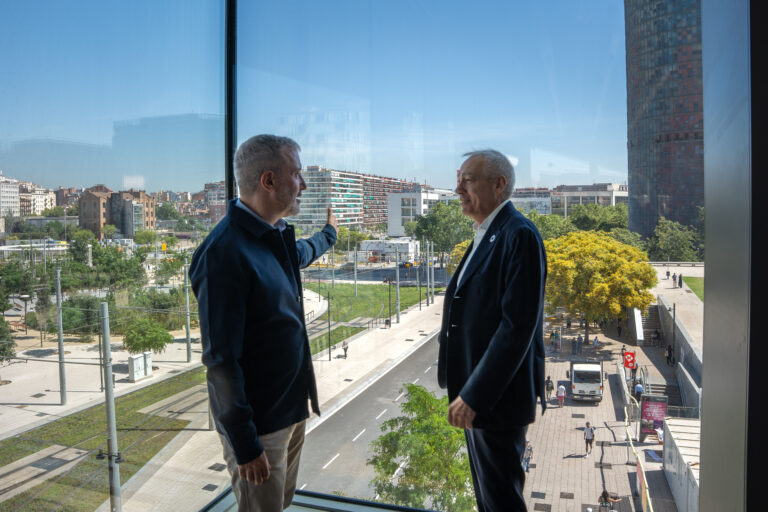
- The Consorci de la Zona Franca will lead the promotion and execution of the project and will assume the initial financing of the works as part of its development, as well as the management of the future office building as the operator of the complex. This is established in the protocol presented today at the DHub by the Mayor of Barcelona, Jaume Collboni, and the Special State Delegate to the Consorci de la Zona Franca, Pere Navarro.
- The architectural project will be selected through a competition to be launched in the coming autumn
Barcelona is taking a step forward in defining the new public tower in Glòries. The Mayor of Barcelona, Jaume Collboni, and the Special State Delegate to the Consorci de la Zona Franca de Barcelona 8CZFB), Pere Navarro, have today presented a protocol to promote this project, which will help strengthen the centrality of one of the city’s most strategic areas and its metropolitan region. The Consorci de la Zona Franca will lead both the promotion and execution of the project and will assume the initial financing of the works, as well as the future management of the office building.
The project will be developed on the plot located at number 254 of Avinguda Diagonal, at the intersection with Gran Via de les Corts Catalanes and Carrer de Ciutat de Granada, in the Sant Martí district. The site covers more than 5,600 m², and its construction responds to the goal of increasing the stock of public housing while consolidating and promoting a city model where residential use, economic activity, and facilities coexist.
The project envisages a minimum above-ground floor area of 35,000 m², with a planned distribution that includes 10,000 m² for subsidized housing, 20,000 m² for administrative uses, and 5,000 m² for community facilities. This combination will increase the supply of public housing, strengthen institutional presence through administrative uses, and expand the district’s network of facilities.
The Mayor of Barcelona, Jaume Collboni, stated that “we are unblocking a long-awaited project to restore its original vocation as a public service, especially designed to address the needs of El Clot and Camp de l’Arpa. With this new proposal, we secure funding, set an initial implementation timeline, and definitively activate this space within an area like Glòries”.
The Spanish authority at the CZFB, Pere Navarro, stated that “since its founding, the CZFB has maintained a strong commitment to the economic promotion of Barcelona and to improving the lives of its citizens. This commitment to the city and to the City Council has always been reflected in concrete projects: the expansion of DFactory Barcelona, which strengthens Barcelona as a hub for urban 4.0 innovation in southern Europe; the ‘Barcelona Plan 2026–2035’ model, promoted on the occasion of the World Architecture Capital, which clearly illustrates how the CZFB places innovation at the service of the city; and the transfer of public land to the City Council to develop more than 1,700 social housing units in the former Sant Andreu barracks and in the Marina del Prat Vermell area”. Navarro added that “today, with the future Public Tower in Glòries, we are taking another step in this same direction. This project is becoming a reality because the City Council and the CZFB are aligned in making useful things happen for Barcelona. I firmly believe that purposeful urban planning, designed with intention and with a public vocation, can positively impact people’s lives. And this is our commitment: to continue working with the City Council to transform public assets into public value, generate opportunities, and contribute to a more balanced, innovative city that serves its citizens”.
The architectural project will be awarded through a competition to be launched next autumn. The timeline foresees the start of the project’s drafting during 2027 and the beginning of the works between late 2028 and early 2029, with the intention that the housing component will be the first to become operational. This new development will contribute to consolidating Plaça de les Glòries as one of the main areas of urban centrality in Barcelona and its metropolitan area.